Last updated August 16, 2026
The Best Tours & Places to Visit in Arizona
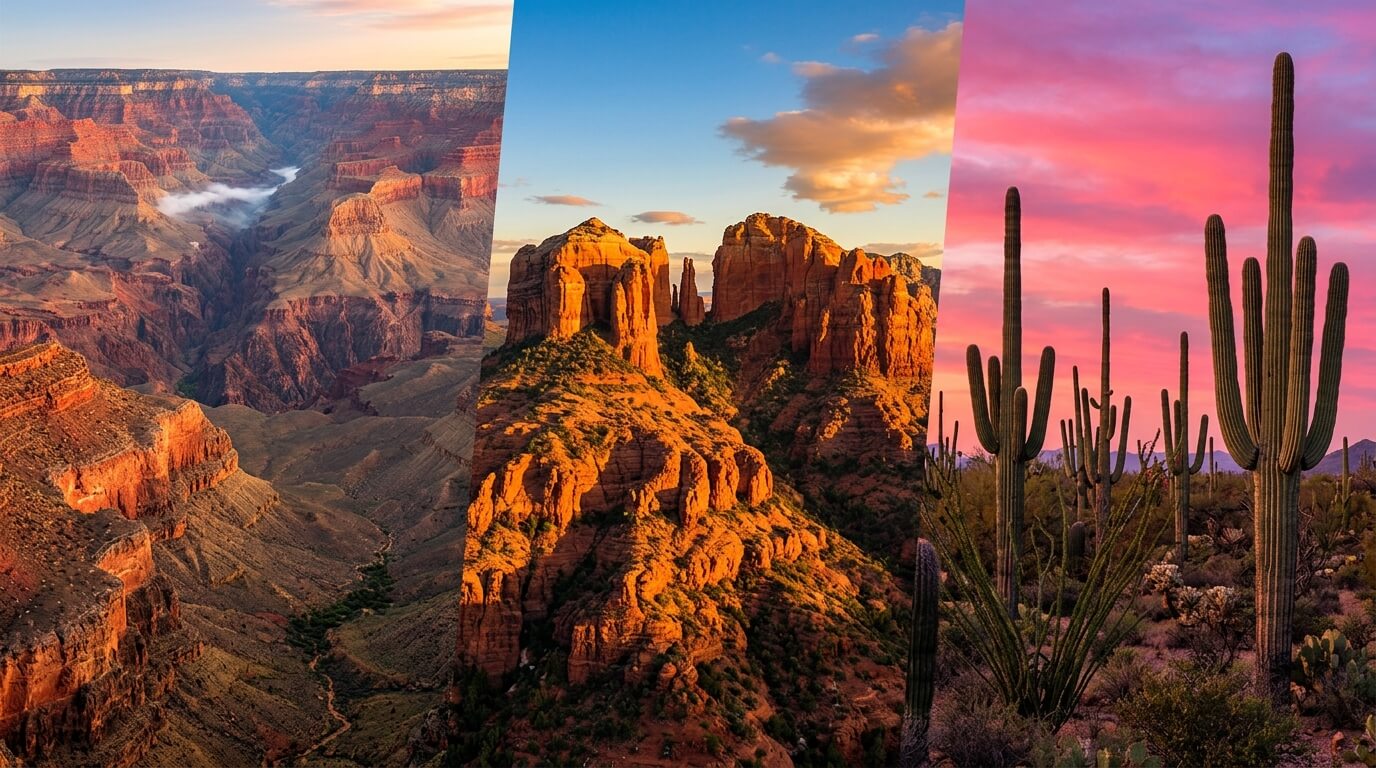
Arizona is a state of extremes, home to one of the seven natural wonders of the world alongside red rock canyons, slot canyons carved from sandstone, and a low desert that swings from mild winter sunshine to some of the hottest summer temperatures in the country. From the mile-deep chasm of the Grand Canyon to the red rock formations of Sedona, the slot canyons near Page, and the desert skyline of Phoenix, Arizona delivers some of the most photographed landscapes in America. Whether you are searching for the best tours in Arizona, tickets to top Arizona attractions, the best places to visit in Arizona, or simply the most memorable things to do in Arizona, this guide covers everything worth knowing before you go.
Top Attractions, Tours and Tickets in Arizona
The Grand Canyon and Northern Arizona
The Grand Canyon is the single most famous natural landmark in Arizona and one of the most visited national parks in the country, stretching 277 miles long and reaching depths over a mile from rim to river. The South Rim, accessible year-round near the gateway town of Tusayan, offers the most developed visitor infrastructure, including the Grand Canyon Skywalk on the separately operated Hualapai Reservation to the west. Guided sightseeing tours departing Flagstaff are one of the easiest ways to see the South Rim without driving yourself, and combination tours pairing the Grand Canyon with Sedona or the Navajo Nation are widely available from Phoenix and Sedona as well. The North Rim, roughly 200 miles further by road, sees a fraction of the visitors and closes seasonally due to snow.
Book a Grand Canyon Tour from Flagstaff →Sedona and Red Rock Country
Sedona's red sandstone formations, framed by juniper and pine forest, make it one of the most photographed towns in the Southwest and a popular base for hiking, mountain biking, and jeep touring. Cathedral Rock, Bell Rock, and Oak Creek Canyon are among the most recognizable formations, and the town has built a substantial tourism industry around guided off-road tours into the surrounding backcountry. Guided jeep tours get visitors onto rugged trails that most rental cars cannot handle, with narration on the area's geology and its reputation for energy vortex sites. Sedona is also a common day-trip base for Grand Canyon and Antelope Canyon tours for travelers who would rather not drive the full distance themselves.
Book a Sedona Red Rock Jeep Tour →Antelope Canyon and Lake Powell
Near the town of Page, Antelope Canyon is one of the most photographed slot canyons in the world, carved from Navajo sandstone into narrow, light-filled corridors of curved rock. The canyon sits on Navajo Nation land and can only be visited with a licensed Navajo guide, split between the more accessible Lower Antelope Canyon and the taller, more photogenic Upper Antelope Canyon. Horseshoe Bend, a dramatic 270-degree bend in the Colorado River, is a short drive away and one of the most recognizable overlooks in the Southwest. Combined Antelope Canyon and Horseshoe Bend tours are the most efficient way to see both in a single day, and advance booking is essential since Navajo-guided slots fill up weeks ahead during summer.
Book an Antelope Canyon & Horseshoe Bend Tour →Phoenix, Scottsdale, and the Sonoran Desert
Phoenix and neighboring Scottsdale anchor the Valley of the Sun, a sprawling desert metro known for resort culture, golf, and some of the best year-round sunshine in the country. Old Town Scottsdale mixes Western heritage with high-end shopping and galleries, while South Mountain Park, one of the largest municipal parks in the country, offers hiking and desert views within city limits. Apache Trail tours with a Canyon Lake cruise are a popular way to see the Sonoran Desert backcountry east of the city, passing through the historic mining town of Goldfield along the way. Spring training baseball, held across the Valley every March, is also a major draw for visitors timing a trip around it.
Book an Apache Trail Tour & Canyon Lake Cruise →Tucson and the Arizona-Sonora Desert Museum
Tucson sits at the heart of the Sonoran Desert and is defined by Saguaro National Park, split into east and west districts on either side of the city, where dense stands of the towering, multi-armed saguaro cactus are unlike anything found outside this specific region of the world. The Arizona-Sonora Desert Museum, part zoo, part botanical garden, part natural history museum, is consistently rated one of the best attractions in the state for understanding the desert's plants, animals, and geology in one stop. Admission tickets to the Desert Museum include its full 98-acre grounds, and the Mission San Xavier del Bac, an active 18th-century Spanish mission just south of downtown, is one of the best-preserved examples of Spanish colonial architecture in the country.
Book Arizona-Sonora Desert Museum Tickets →Old West History in Tombstone
Tombstone built its name on the 1881 gunfight at the O.K. Corral and has leaned into that history ever since, with Allen Street's wooden boardwalks, staged gunfight reenactments, and the Boothill Graveyard where many of the town's most notorious characters are buried. The Bird Cage Theatre, once a 24-hour saloon, dance hall, and gambling parlor, still shows bullet holes from its rowdiest years, and the nearby copper mining town of Bisbee pairs well as a same-day stop for travelers heading south from Tucson or Phoenix. Guided walking tours cover both the town's Old West history and its reputation as one of the most haunted small towns in the Southwest.
Book a Tombstone Walking Tour →Flagstaff and the High Country
Flagstaff sits at over 7,000 feet in elevation, which makes it Arizona's coolest major city and a starting point for visitors heading to both the Grand Canyon and Sedona. Historic Route 66 runs directly through downtown, and the Lowell Observatory, where Pluto was discovered in 1930, still operates as a working research and public observatory with evening stargazing programs. Oak Creek Canyon, the scenic drive connecting Flagstaff to Sedona, and Walnut Canyon National Monument, home to centuries-old cliff dwellings, both make worthwhile stops for travelers with a car and a few extra hours.
Major Cities and Places to Visit in Arizona
- Phoenix Tours & Tickets - Arizona's capital and largest city, home to Old Town Scottsdale nearby, spring training baseball, and year-round desert sunshine
- Tucson Tours & Tickets - Saguaro National Park, the Arizona-Sonora Desert Museum, and Mission San Xavier del Bac
- Sedona Tours & Tickets - Red rock formations, jeep tours, hiking trails, and a base for Grand Canyon day trips
- Flagstaff Tours & Tickets - Historic Route 66, the Lowell Observatory, and the closest major city to the Grand Canyon's South Rim
- Scottsdale Tours & Tickets - Old Town shopping and galleries, resort culture, and desert golf courses
- Page Tours & Tickets - Gateway to Antelope Canyon, Horseshoe Bend, and Lake Powell on the Utah border
- Tombstone Tours & Tickets - O.K. Corral gunfight history, Boothill Graveyard, and Old West walking tours
- Bisbee Tours & Tickets - A historic copper mining town turned artist community, with underground mine tours
- Prescott Tours & Tickets - Arizona's former territorial capital, with a historic courthouse square and Whiskey Row
- Tusayan Tours & Tickets - The main gateway town to the Grand Canyon's South Rim, a mile from the park entrance
Universities, Colleges and Sports Teams in Arizona
- University of Arizona in Tucson - One of the state's two major research universities, with strong programs in astronomy and optical sciences.
- Arizona Wildcats (sports team) in Tucson - NCAA Division I program with a particularly strong basketball tradition.
- Northern Arizona University in Flagstaff - A mid-sized public university known for forestry, hospitality, and health sciences programs.
- NAU Lumberjacks (sports team) in Flagstaff - NCAA Division I program, notably strong in cross country and track and field given Flagstaff's high-altitude training conditions.
- Arizona State University - The state's largest university by enrollment, based in Tempe just outside Phoenix.
- Arizona State Sun Devils (sports team) - NCAA Division I program across dozens of sports, including a strong wrestling and swimming tradition.
Arizona Demographics and Population
According to the 2024 American Community Survey, Arizona has a population of approximately 7,378,838 people across 113,998 square miles, ranking it 14th among U.S. states by population. The median household income is $79,964, and the largest racial and ethnic groups are White (52.4%), Hispanic (32.1%), and American Indian and Alaska Native (3.7%). The median age is 39.0 years. Approximately 12.4% of residents live below the poverty line, compared to the national rate of 12.2%. Arizona's economy is driven by tourism and hospitality, a fast-growing semiconductor and technology manufacturing sector centered on Phoenix, real estate and construction tied to sustained population growth, and a large retiree population concentrated in the Phoenix metro area.
When to Visit Arizona
Spring (March through May) is the best time to visit Arizona. The best time to visit Arizona overall. Wildflowers bloom across the desert, daytime temperatures in Phoenix and Tucson are comfortable, and Grand Canyon and Sedona trails are typically clear of snow. Winter (December through February): Peak season in the low desert cities of Phoenix, Scottsdale, and Tucson, with mild, sunny days that draw large numbers of seasonal residents. Northern Arizona, including Flagstaff and the Grand Canyon's North Rim, can see significant snow and seasonal closures. Summer (June through August): Extremely hot in the low desert, with Phoenix regularly exceeding 110 degrees Fahrenheit, though the high country around Flagstaff and Sedona stays noticeably cooler and remains a popular summer escape for desert residents. Fall (September through November): A comfortable shoulder season once the summer heat breaks in October, with fewer crowds than spring at major attractions like the Grand Canyon and Sedona.
Frequently Asked Questions About Touring Arizona
Official Arizona Resources
The following official government websites provide additional planning resources, park information, and historical records for travelers visiting Arizona.
| Resource | Description | Website |
|---|---|---|
| State of Arizona | Official state government portal with links to all state agencies and services | az.gov |
| Visit Arizona | Official state tourism website with travel guides and trip planning tools | www.visitarizona.com |
| Arizona State Parks & Trails | Official site for Arizona's state park system, including reservations, trails, and camping | azstateparks.com |
| Arizona Game and Fish Department | State agency covering fishing and hunting regulations, licenses, and wildlife information | www.azgfd.com |
| Grand Canyon National Park | Official National Park Service site for the Grand Canyon, including entry passes and shuttle information | www.nps.gov/grca |
| Saguaro National Park | Official National Park Service site for Saguaro National Park, near Tucson | www.nps.gov/sagu |
| Arizona-Sonora Desert Museum | Official site for the Tucson museum covering the plants, animals, and geology of the Sonoran Desert | www.desertmuseum.org |
| Navajo Nation Parks and Recreation | Official permitting and information site for Navajo Nation land, including Antelope Canyon and Monument Valley | navajonationparks.org |
| Arizona State Library, Archives and Public Records | State agency preserving historical government records, manuscripts, and photographs | azlibrary.gov/archives |
| Arizona Census Data | Official U.S. Census Bureau QuickFacts for Arizona population and demographic statistics | www.census.gov/quickfacts/AZ |