Last updated August 17, 2026
The Best Tours & Places to Visit in Texas
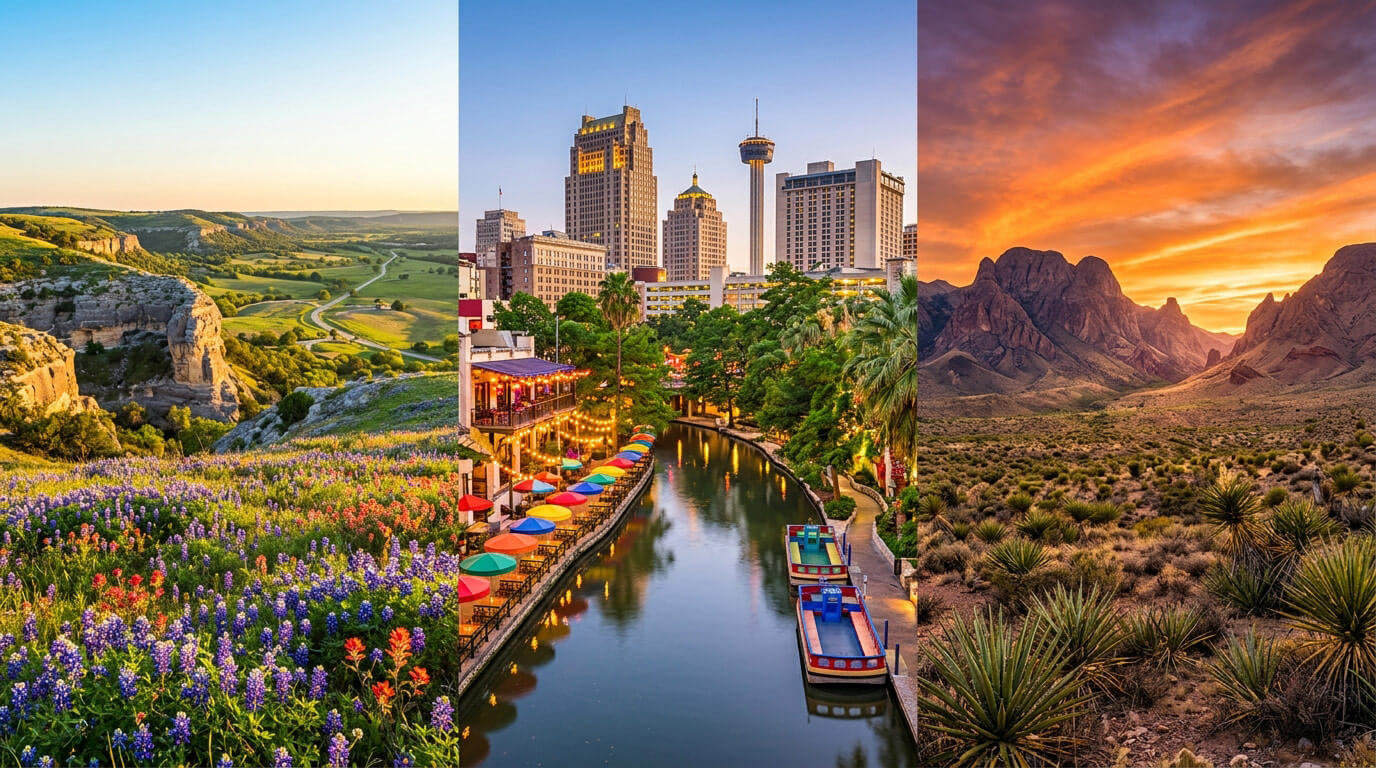
Texas is the second-largest state in the country by both area and population, and it genuinely takes a road trip mindset to see much of it, since the drive from El Paso to Houston covers roughly the same distance as Chicago to New York. San Antonio anchors the state's Spanish colonial history at the Alamo, Houston runs NASA's human spaceflight program at Space Center Houston, and Austin has built a national reputation as a live music and tech hub, all while Dallas-Fort Worth carries its own identity built around football and Western heritage. Beyond the big cities, the Texas Hill Country's wine country, the remote canyons of Big Bend National Park, and the Gulf Coast's beaches show just how much variety fits inside one state's borders.
Top Attractions, Tours and Tickets in Texas
San Antonio: The Alamo & River Walk
The Alamo, site of the 13-day 1836 siege that became the rallying cry of the Texas Revolution, sits directly in downtown San Antonio, a few blocks from the River Walk, a network of landscaped paths and cafes running below street level along the San Antonio River. San Antonio's Spanish colonial missions, including the Alamo itself, form a UNESCO World Heritage Site, the only one in Texas, and Mission San José, the largest of the four other missions, still holds an active parish. La Villita, the city's original settlement, and the 750-foot Tower of the Americas round out a day spent downtown.
Book San Antonio City Tour with Alamo & River Walk CruiseHouston & Space Center Houston
Houston earned the nickname "Space City" as home to NASA's Johnson Space Center, the mission control hub for U.S. human spaceflight since the Gemini program in the 1960s. Space Center Houston, the center's public visitor complex, includes the actual Mission Control room used for Apollo 11, a full-scale shuttle replica mounted on a real retired NASA jet, and tram tours through active astronaut training facilities. Beyond NASA, Houston's Museum District holds nearly 20 museums within walking distance of each other, and the city's food scene, shaped by one of the most ethnically diverse populations in the country, rivals any city in the state.
Book Space Center Houston Admission TicketAustin: Live Music & the Capitol
Austin calls itself the live music capital of the world, with more music venues per capita than any other U.S. city and a packed calendar built around events like South by Southwest and Austin City Limits. The Texas State Capitol, completed in 1888 and taller than the U.S. Capitol in Washington, D.C., anchors downtown, while South Congress Avenue's boutiques and food trucks and the swimming hole at Barton Springs Pool give the city a laid-back counterpoint to its tech-industry growth. Lady Bird Lake's hike-and-bike trail loops directly through downtown, making it easy to see much of the city on foot or by rented bike.
Book Best of Austin Guided TourDallas-Fort Worth
Dallas and Fort Worth anchor opposite ends of the Metroplex with distinct identities: Dallas leans toward finance, fashion, and the site of President Kennedy's 1963 assassination at Dealey Plaza, now home to the Sixth Floor Museum, while Fort Worth keeps its Western heritage alive at the Stockyards National Historic District, where longhorn cattle are still driven down East Exchange Avenue twice a day. AT&T Stadium, home of the Dallas Cowboys, is one of the largest domed stadiums in the world and offers tours even on non-game days. The Dallas Arts District, one of the largest contiguous urban arts districts in the country, adds a cultural counterweight to the region's sports-heavy reputation.
Book JFK Assassination & Sixth Floor Museum TourTexas Hill Country & Fredericksburg Wine Country
Fredericksburg, founded by German immigrants in 1846, still carries its heritage in its bakeries, biergartens, and Sunday Houses, small in-town cottages farm families once used on trips into town. The surrounding Texas Hill Country has grown into the state's primary wine region over the past two decades, with more than 50 wineries now operating along Highway 290 between Fredericksburg and Johnson City. Nearby, the LBJ Ranch, President Lyndon B. Johnson's "Texas White House," and the granite dome of Enchanted Rock State Natural Area round out a Hill Country day trip from either Austin or San Antonio.
Book Fredericksburg Hill Country Wine TourBig Bend National Park & West Texas
Big Bend National Park, named for the sharp bend the Rio Grande makes along the Texas-Mexico border, is one of the least-visited and most remote national parks in the contiguous United States, requiring at least a three-hour drive from the nearest sizable airport. The park spans desert, river canyons, and the Chisos Mountains, the only mountain range entirely contained within a single national park, and its remote location makes it one of the best stargazing spots in the country, designated an International Dark Sky Park. Rafting the Rio Grande through Santa Elena Canyon, its walls rising 1,500 feet straight up from the river, is one of the park's signature experiences.
Book Big Bend Self-Guided Driving Audio TourThe Gulf Coast & Galveston
Galveston, on a barrier island roughly an hour from Houston, rebuilt itself after a catastrophic 1900 hurricane that remains the deadliest natural disaster in U.S. history, and its Strand Historic District still holds one of the largest collections of Victorian-era iron-front buildings in the country. Moody Gardens' glass pyramids and Galveston Island State Park give the city both a family-attraction side and a quieter beach side, while the Bolivar Ferry, free to ride, connects the island to the Bolivar Peninsula with dolphin sightings a common bonus along the way. Farther down the coast, South Padre Island offers a warmer, more tropical stretch of Gulf beach closer to the Mexican border.
Major Cities and Places to Visit in Texas
- Houston Tours & Tickets - Texas's largest city and the country's fourth-largest, home to NASA's Johnson Space Center, a vast international food scene, and one of the largest medical centers in the world.
- San Antonio Tours & Tickets - A Texas history hub built around the Alamo and the River Walk, with the deepest Spanish colonial roots of any major Texas city.
- Dallas Tours & Tickets - A Metroplex anchor city known for the JFK assassination site at Dealey Plaza, the Dallas Cowboys, and an upscale shopping and arts scene.
- Austin Tours & Tickets - Texas's state capital and self-declared live music capital of the world, ringed by the Texas Hill Country and home to the University of Texas.
- Fort Worth Tours & Tickets - Dallas's Western-heritage twin city, home to the Fort Worth Stockyards and twice-daily longhorn cattle drives down its historic streets.
- El Paso Tours & Tickets - A West Texas border city on the Rio Grande across from Ciudad Juárez, Mexico, with a distinct desert and bicultural identity from the rest of the state.
- Galveston Tours & Tickets - A Gulf Coast island city with Victorian architecture, a historic seawall, and Texas's busiest cruise port outside of the Houston area.
- Fredericksburg Tours & Tickets - A Texas Hill Country town founded by German immigrants in 1846, now the center of Texas wine country and known for its German bakeries and biergartens.
Universities, Colleges and Sports Teams in Texas
- University of Texas at Austin in Austin - The state's flagship public research university in Austin, home of the Texas Longhorns.
- Texas A&M University - A public land-grant research university based in College Station, home of the Texas A&M Aggies.
- Rice University in Houston - A private research university in Houston, consistently ranked among the top universities in the country.
- Dallas Cowboys (sports team) in Dallas - NFL franchise playing home games at AT&T Stadium in Arlington, one of the most valuable sports franchises in the world.
- Houston Astros (sports team) in Houston - MLB franchise playing home games at Daikin Park in downtown Houston.
- San Antonio Spurs (sports team) in San Antonio - NBA franchise with five championships, playing home games at the Frost Bank Center.
- Dallas Mavericks (sports team) in Dallas - NBA franchise playing home games at the American Airlines Center in downtown Dallas.
Texas Demographics and Population
According to the 2024 American Community Survey, Texas has a population of approximately 31,290,831 people across 261,259 square miles, ranking it 2nd among U.S. states by population. The median household income is $79,721, and the largest racial and ethnic groups are Asian (5.6%), White (38.7%), Hispanic Latino (39.8%), American Indian and Alaska Native (1%), and Black or African American (12.2%). The median age is 35.9 years, and the per capita income is $41,614. Approximately 13.4% of residents live below the poverty line, compared to the national rate of 12.5%. Texas has 11,449,769 households and a mean commute time of 27.5 minutes. Texas has no state income tax, and its economy is one of the largest and most diverse in the country, anchored by energy production around Houston, technology in Austin, finance in Dallas, and NASA's human spaceflight program at the Johnson Space Center.
When to Visit Texas
Winter (December through February): Generally mild, especially in South Texas, though occasional cold snaps and ice storms can affect the whole state, including areas with little infrastructure to handle them. Spring (March through May): Warm and colorful, with bluebonnets and other wildflowers blooming across the Hill Country and roadsides statewide, typically peaking in late March and April. Summer (June through August): Extremely hot across most of the state, especially in West Texas and South Texas, making early morning or evening the best times for outdoor activities like Big Bend hiking. Fall (September through November) is the best time to visit Texas. Cooling and comfortable, generally considered the best season for outdoor activities statewide, coinciding with the start of college football season.
Frequently Asked Questions About Touring Texas
Official Texas Resources
The following official government websites provide additional planning resources, park information, and historical records for travelers visiting Texas.
| Resource | Description | Website |
|---|---|---|
| Travel Texas | The state's official travel and tourism site with attraction guides, events, and trip planning tools. | www.traveltexas.com/ |
| Texas Parks and Wildlife Department | Official listing of the state's 89 state parks and natural areas, including Big Bend Ranch and Enchanted Rock. | tpwd.texas.gov/ |
| Texas State Library and Archives Commission | State agency responsible for preserving historical government records and documents for research and genealogy. | www.tsl.texas.gov/ |
| Texas.gov | The official portal for Texas state government services and information. | www.texas.gov/ |