Last updated August 16, 2026
The Best Tours & Places to Visit in Maryland
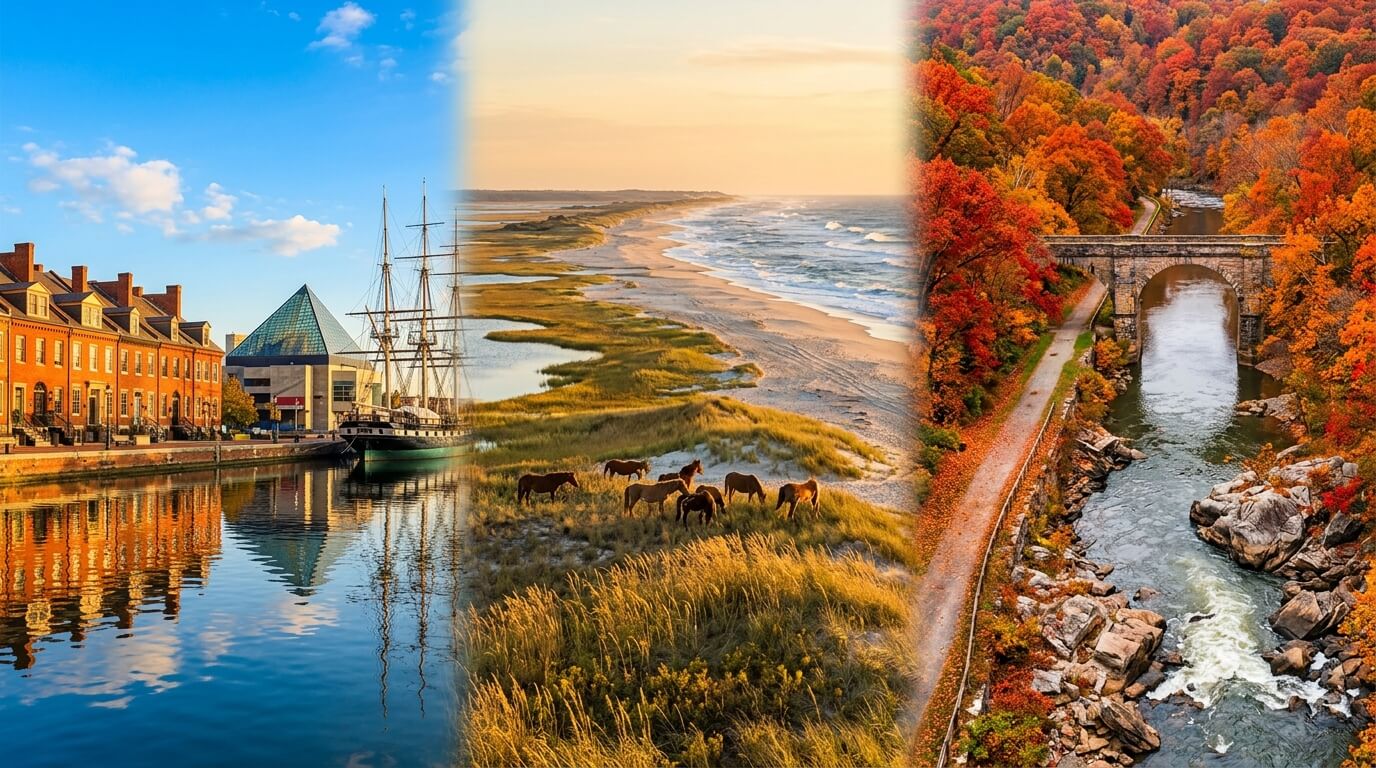
Maryland packs an unusual amount of geographic and historical variety into one of the smallest states in the country, from a working harbor city that helped inspire the national anthem to a bay that has shaped the state's economy and identity for centuries. From the aquarium and Fort McHenry in Baltimore to the colonial streets and Naval Academy of Annapolis, the wild horses of Assateague Island, and the crab houses lining the Chesapeake Bay, Maryland rewards travelers who explore beyond the DC suburbs. Whether you are searching for the best tours in Maryland, tickets to top Maryland attractions, the best places to visit in Maryland, or simply the most memorable things to do in Maryland, this guide covers everything worth knowing before you go.
Top Attractions, Tours and Tickets in Maryland
Baltimore's Inner Harbor and Fort McHenry
Baltimore's Inner Harbor has transformed from a working industrial waterfront into the city's main tourism hub, ringed by museums, restaurants, and the historic sailing ships of the Baltimore Maritime Museum. Fort McHenry, a short distance away, successfully defended the harbor from British bombardment in 1814, an event Francis Scott Key witnessed and later immortalized in what became The Star-Spangled Banner. Inner Harbor sightseeing cruises pass Fort McHenry, the Domino Sugar sign, and the historic USS Constellation, and Oriole Park at Camden Yards, widely credited with launching the modern trend of retro-style ballparks, sits within easy walking distance downtown.
Book a Baltimore Inner Harbor Cruise →The National Aquarium
The National Aquarium anchors Baltimore's Inner Harbor with more than 20,000 fish, birds, amphibians, reptiles, and marine mammals spread across exhibits that recreate environments from Australian rainforest to Atlantic coral reef. The multi-story open ocean shark tank and the Blacktip Reef exhibit, home to a mix of reef fish and small sharks, rank among the aquarium's most popular stops, and dolphin presentations at the adjoining amphitheater remain a highlight for family visitors. National Aquarium tickets include access to all exhibit levels, and advance booking is recommended during summer months and school holidays when timed entry slots sell out.
Book National Aquarium Tickets →Annapolis and the Naval Academy
Annapolis served briefly as the capital of the United States in 1783 and 1784, and its colonial-era street grid, centered on the Maryland State House, remains one of the best-preserved in the country, with more surviving 18th-century buildings than almost anywhere else in America. The United States Naval Academy, founded in 1845, occupies a large waterfront campus within the historic district, its Beaux-Arts chapel and the crypt of John Paul Jones among the most visited stops for guided visitors. Guided tours covering colonial Annapolis, the State House, and the Naval Academy combine the city's two defining identities into a single walk, and harbor cruises past the Academy's waterfront buildings offer a view most land-based visitors never see.
Book an Annapolis & Naval Academy Tour →Antietam and Civil War History
Antietam National Battlefield preserves the site of the single bloodiest day in American military history, when nearly 23,000 soldiers were killed, wounded, or went missing on September 17, 1862, as Union forces halted the first Confederate invasion of the North. The Cornfield, Sunken Road, known as Bloody Lane for the intensity of fighting there, and Burnside Bridge remain largely unchanged from the battle, giving visitors an unusually intact sense of the terrain that shaped the day's tactics. Guided battlefield tours from Washington, D.C. cover the battle's key sites and its role in prompting Lincoln's preliminary Emancipation Proclamation, and nearby Harpers Ferry, West Virginia, ties directly into the same campaign for visitors with time for a longer day trip.
Book an Antietam Battlefield Tour →Assateague Island and the Wild Horses
Assateague Island National Seashore protects a barrier island shared between Maryland and Virginia, best known for the wild, free-roaming horses that have lived on the island for centuries, most likely descended from domestic stock brought over by colonial-era farmers. Maryland's side of the island offers less-developed, more natural beach access than the Virginia side near Chincoteague, along with camping directly on the dunes for visitors who want an extended stay. Herds are managed separately on each side of the state line by a fence roughly at the border, and sightings are common but never guaranteed, since the horses roam freely across the island's beaches, marshes, and pine forest.
The Chesapeake Bay and Crab Culture
The Chesapeake Bay, the largest estuary in the United States, has shaped Maryland's food culture, economy, and identity for centuries, and blue crabs, typically steamed whole with Old Bay seasoning and eaten at newspaper-covered picnic tables, remain the state's single most identifiable dish. Towns like St. Michaels and Solomons on the bay's shores retain a strong maritime heritage, documented in depth at the Chesapeake Bay Maritime Museum and the Calvert Marine Museum, both built around the region's watermen and skipjack sailing history. Sailing, crabbing, and oyster harvesting remain genuine working industries on the bay rather than purely tourist activities, and boat charters out of towns up and down the shoreline offer visitors a way to experience that working water firsthand.
Ocean City and the Eastern Shore
Ocean City anchors Maryland's Atlantic coastline with a three-mile boardwalk, amusement piers, and a dense strip of hotels that make it the state's dominant beach resort town, drawing crowds from across the Mid-Atlantic each summer. The broader Eastern Shore, separated from the rest of Maryland by the Chesapeake Bay, moves at a noticeably slower pace, with small towns like Chestertown and Berlin preserving colonial and Victorian-era architecture largely untouched by the coastal development further south. Berlin, in particular, has earned national recognition for its preserved downtown and serves as the most convenient gateway to Assateague Island for visitors approaching from the Maryland side.
Major Cities and Places to Visit in Maryland
- Baltimore Tours & Tickets - The Inner Harbor, the National Aquarium, Fort McHenry, and Oriole Park at Camden Yards
- Annapolis Tours & Tickets - Maryland's colonial-era state capital, the U.S. Naval Academy, and a historic sailing harbor
- Ocean City Tours & Tickets - Maryland's main Atlantic beach resort, with a three-mile boardwalk and amusement piers
- Frederick Tours & Tickets - A walkable historic downtown along Carroll Creek, with Civil War-era architecture
- St. Michaels Tours & Tickets - A Chesapeake Bay sailing town home to the Chesapeake Bay Maritime Museum
- Berlin Tours & Tickets - A well-preserved Eastern Shore town and the closest base for Assateague Island
- Sharpsburg Tours & Tickets - The small town nearest Antietam National Battlefield, site of the Civil War's bloodiest single day
- Cumberland Tours & Tickets - A Western Maryland mountain town along the historic National Road and C&O Canal
- Solomons Tours & Tickets - A Chesapeake Bay boating town home to the Calvert Marine Museum
- Chestertown Tours & Tickets - A well-preserved colonial river town on Maryland's Eastern Shore
Universities, Colleges and Sports Teams in Maryland
- University of Maryland - The state's flagship public university, based in College Park just outside Washington, D.C.
- Maryland Terrapins (sports team) - NCAA Division I program competing in the Big Ten Conference.
- United States Naval Academy in Annapolis - The federal service academy for the U.S. Navy and Marine Corps, founded in 1845.
- Navy Midshipmen (sports team) in Annapolis - NCAA Division I program whose football team maintains one of the sport's most storied service academy rivalries.
Maryland Demographics and Population
According to the 2024 American Community Survey, Maryland has a population of approximately 6,263,220 people across 12,407 square miles, ranking it 19th among U.S. states by population. The median household income is $102,905, and the largest racial and ethnic groups are Asian (6.5%), White (46.6%), Hispanic (12.5%), and Black or African American (28.9%). The median age is 39.8 years. Approximately 9.1% of residents live below the poverty line, compared to the national rate of 12.2%. Maryland's economy is shaped heavily by its proximity to Washington, D.C., with federal government employment, defense contracting, and biotechnology research anchored around the National Institutes of Health, along with the Port of Baltimore's shipping and logistics industry and Chesapeake Bay seafood harvesting.
When to Visit Maryland
Fall (September through November) is the best time to visit Maryland. The best time to visit Maryland. Humidity drops after a hot Mid-Atlantic summer, foliage turns across Western Maryland and Antietam, and crowds thin out at Ocean City and Assateague. Summer (June through August): Warm and busy, with Ocean City and Assateague Island at their most crowded and blue crab season in full swing around the Chesapeake Bay. Spring (March through May): A comfortable shoulder season, and a good time to see Assateague's wild horses and migrating birds before summer crowds arrive. Winter (December through February): Cold with occasional snow, especially in Western Maryland, and the quietest season for Ocean City and the Eastern Shore, though Baltimore's museums and the Naval Academy stay open year-round.
Frequently Asked Questions About Touring Maryland
Official Maryland Resources
The following official government websites provide additional planning resources, park information, and historical records for travelers visiting Maryland.
| Resource | Description | Website |
|---|---|---|
| State of Maryland | Official state government portal with links to all state agencies and services | www.maryland.gov |
| Visit Maryland | Official state tourism website with travel guides and trip planning tools | www.visitmaryland.org |
| Maryland Department of Natural Resources | State agency overseeing Maryland state parks, fishing and hunting regulations, and Chesapeake Bay conservation | dnr.maryland.gov |
| Assateague Island National Seashore | Official National Park Service site for Assateague Island, including the wild horse population | www.nps.gov/asis |
| Antietam National Battlefield | Official National Park Service site for Antietam | www.nps.gov/anti |
| Fort McHenry National Monument and Historic Shrine | Official National Park Service site for Fort McHenry in Baltimore | www.nps.gov/fomc |
| Maryland State Archives | State agency preserving historical government records dating to Maryland's founding in 1634 | msa.maryland.gov |
| Maryland Census Data | Official U.S. Census Bureau QuickFacts for Maryland population and demographic statistics | www.census.gov/quickfacts/MD |