Last updated August 16, 2026
The Best Tours & Places to Visit in Nebraska
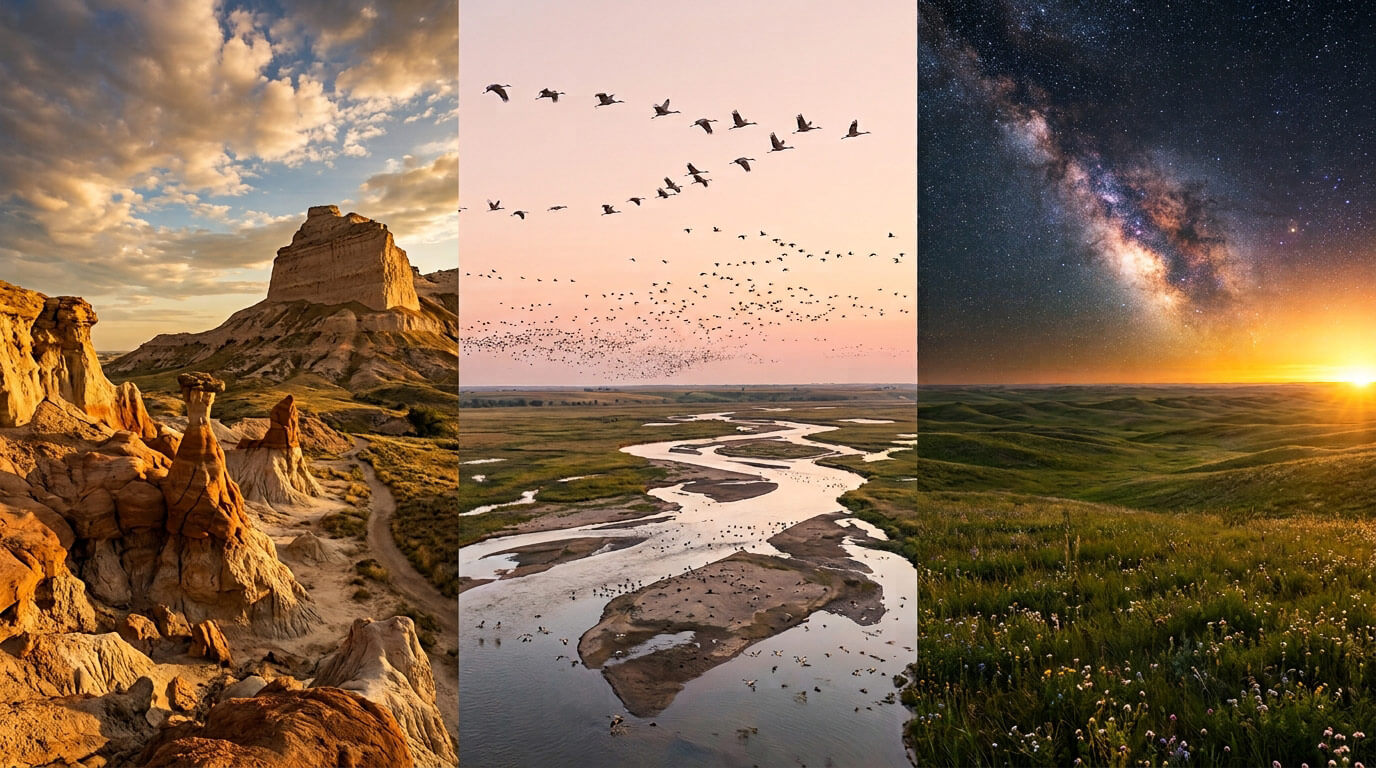
Nebraska rarely appears on anyone's bucket list, but the state holds one of the best zoos in the world, a chain of Oregon Trail landmarks that guided hundreds of thousands of pioneers west, and a roadside attraction built entirely from junked cars. From the zoo and riverfront of Omaha to the university energy of Lincoln, the pioneer-era landmarks of Chimney Rock and Scotts Bluff, and the sheer strangeness of Carhenge, Nebraska rewards travelers willing to look past its reputation as flat, featureless farm country. Whether you are searching for the best tours in Nebraska, tickets to top Nebraska attractions, the best places to visit in Nebraska, or simply the most memorable things to do in Nebraska, this guide covers everything worth knowing before you go.
Top Attractions, Tours and Tickets in Nebraska
Omaha's Henry Doorly Zoo and Aquarium
Omaha's Henry Doorly Zoo and Aquarium is regularly ranked among the best zoos in the world, home to the largest indoor rainforest in the world under one roof, one of the largest indoor desert exhibits, and a cat complex holding one of the most diverse big cat collections in North America. The zoo's scale genuinely surprises first-time visitors, who often expect a modest regional facility and instead find an operation that rivals major zoos in far larger cities. Tickets are sold directly through the zoo's own website rather than third-party tour marketplaces, and visiting on a weekday or during shoulder season significantly cuts down on the crowds that build up during summer weekends.
Omaha's Old Market and Riverfront
Omaha's Old Market district preserves a several-block stretch of late 19th-century warehouse architecture, its cobblestone streets now lined with independent restaurants, art galleries, and shops that have made it the city's most walkable historic district. The Gene Leahy Mall and the wider riverfront park system along the Missouri River have been substantially rebuilt in recent years, connecting downtown to the Bob Kerrey Pedestrian Bridge, which crosses the river into Iowa. Omaha's history as a major stockyards and meatpacking city, and later as the headquarters of Warren Buffett's Berkshire Hathaway, gives the Old Market's revitalization a genuine sense of a working city reinventing itself rather than a purely manufactured tourist district.
Lincoln and Nebraska Football
Nebraska Cornhusker football at Memorial Stadium in Lincoln holds one of the longest continuous sellout streaks in American sports history, and on game days the stadium technically becomes the third-largest city in the state by population for the afternoon. The Nebraska State Capitol, a 400-foot Art Deco tower completed in 1932, remains one of the more architecturally distinctive state capitols in the country, topped by a bronze statue known as The Sower. The University of Nebraska's Sheldon Museum of Art and the Lincoln Children's Zoo round out a college town that punches well above its size in cultural institutions relative to its population.
Chimney Rock and the Oregon Trail
Chimney Rock, a slender spire of clay and volcanic ash rising nearly 300 feet above the North Platte River valley, was the single most-mentioned landmark in pioneer diaries along the Oregon, California, and Mormon Trails, a reassuring sign to hundreds of thousands of westbound travelers that they had made real progress. The rock has eroded noticeably even within recorded history, and a visitor center at its base explains both its geology and the wagon train era that made it so significant. Nearby Ash Hollow and Windlass Hill preserve some of the best-remaining wagon ruts anywhere along the trail system, worn into the hillside by thousands of wheels over decades of westward migration.
Scotts Bluff National Monument
Scotts Bluff rises 800 feet above the North Platte River, and pioneers on the Oregon Trail regarded passing it as a genuine milestone, since its badlands terrain forced wagon trains into a narrow gap now followed roughly by the modern highway. A paved summit road climbs to the top for panoramic views across the valley, and the visitor center's museum includes photographs and paintings by William Henry Jackson, whose images of the trail remain some of the most important visual records of westward migration. The Oregon Trail Pathway, a walkable trail near the visitor center, still shows original wagon ruts left by the estimated 250,000 emigrants who passed this exact point on their way west.
Carhenge and the Nebraska Panhandle
Carhenge, built in 1987 near Alliance, recreates the scale and layout of England's Stonehenge using 39 vintage American automobiles, half-buried nose-down or stacked and welded into place, a genuinely odd roadside monument that has become one of the most photographed attractions in western Nebraska. The surrounding Nebraska Panhandle stretches into noticeably different terrain than the rest of the state, with the pine-covered buttes of the Pine Ridge region near Chadron feeling closer to the Black Hills of South Dakota than to Nebraska's eastern farmland. Toadstool Geologic Park, a badlands landscape of eroded rock formations and fossil beds northwest of Crawford, rounds out the Panhandle's reputation as the least expected corner of the state.
The Sandhills and Rural Nebraska
The Nebraska Sandhills cover roughly a quarter of the state with grass-stabilized sand dunes, the largest dune formation in the Western Hemisphere, now used almost entirely for cattle ranching since the fragile sandy soil makes conventional farming impractical. Each spring, roughly 80 percent of the world's sandhill crane population stops along the Platte River near Kearney during migration, drawing birdwatchers to viewing blinds along the riverbank for one of the largest wildlife spectacles in North America. The region's vast, empty highways and small ranching towns offer a genuinely different version of Nebraska than either Omaha or Lincoln, rewarding travelers willing to slow down for a landscape most people only fly over.
Major Cities and Places to Visit in Nebraska
- Omaha Tours & Tickets - Home to the Henry Doorly Zoo and Aquarium, regularly ranked among the best zoos in the world
- Lincoln Tours & Tickets - Nebraska's state capital and home to Nebraska Cornhusker football's sold-out Memorial Stadium
- Alliance Tours & Tickets - Home to Carhenge, a roadside recreation of Stonehenge built entirely from vintage automobiles
- Gering Tours & Tickets - The town beneath Scotts Bluff National Monument, a major Oregon Trail landmark
- Kearney Tours & Tickets - Home to the Great Platte River Road Archway and the spring sandhill crane migration
- Grand Island Tours & Tickets - Home to the Stuhr Museum of the Prairie Pioneer, a large open-air pioneer history complex
- North Platte Tours & Tickets - Home to Buffalo Bill Cody's Scout's Rest Ranch and one of the world's largest rail yards
- Chadron Tours & Tickets - A Nebraska Panhandle town near the pine-covered buttes of the Pine Ridge region
- Ogallala Tours & Tickets - A former cattle-drive boomtown once known as the Gomorrah of the Plains
- Nebraska City Tours & Tickets - The birthplace of Arbor Day, with orchards and the historic Lied Lodge
Universities, Colleges and Sports Teams in Nebraska
- University of Nebraska-Lincoln in Lincoln - The state's flagship public university, home to one of the longest sellout streaks in college football history.
- Nebraska Cornhuskers (sports team) in Lincoln - NCAA Division I program competing in the Big Ten Conference, with a passionately followed football tradition.
Nebraska Demographics and Population
According to the 2024 American Community Survey, Nebraska has a population of approximately 1,978,707 people across 77,355 square miles, ranking it 37th among U.S. states by population. The median household income is $76,475, and the largest racial and ethnic groups are Asian (2.6%), White (75.3%), Hispanic (12.7%), American Indian and Alaska Native (1%), and Black or African American (4.6%). The median age is 37.1 years. Approximately 10.6% of residents live below the poverty line, compared to the national rate of 12.2%. Nebraska's economy is anchored by agriculture, particularly corn, soybeans, and cattle, insurance and financial services headquartered in Omaha, including Berkshire Hathaway and Mutual of Omaha, and a growing logistics and food processing sector.
When to Visit Nebraska
Fall (September through November) is the best time to visit Nebraska. The best time to visit Nebraska. Temperatures are comfortable statewide, humidity drops, and Nebraska Cornhusker football fills Lincoln every home Saturday. Spring (March through May): A close second to fall, and the timing for the sandhill crane migration along the Platte River near Kearney each March, one of the largest wildlife spectacles in North America. Summer (June through August): Warm and the peak season for the Henry Doorly Zoo and Oregon Trail landmarks in the Panhandle, though heat and humidity can be intense in eastern Nebraska. Winter (December through February): Cold with occasional snow and strong winds across the open plains, and the quietest season for outdoor attractions statewide.
Frequently Asked Questions About Touring Nebraska
Official Nebraska Resources
The following official government websites provide additional planning resources, park information, and historical records for travelers visiting Nebraska.
| Resource | Description | Website |
|---|---|---|
| State of Nebraska | Official state government portal with links to all state agencies and services | www.nebraska.gov |
| Visit Nebraska | Official state tourism website with travel guides and trip planning tools | visitnebraska.com |
| Nebraska Game and Parks Commission | State agency overseeing Nebraska state parks, wildlife, and fishing and hunting regulations | outdoornebraska.gov |
| Scotts Bluff National Monument | Official National Park Service site for Scotts Bluff | www.nps.gov/scbl |
| Henry Doorly Zoo and Aquarium | Official site for the Omaha zoo, including tickets and visitor information | www.omahazoo.com |
| Nebraska State Historical Society | State agency preserving historical government records and documents | history.nebraska.gov |
| Nebraska Census Data | Official U.S. Census Bureau QuickFacts for Nebraska population and demographic statistics | www.census.gov/quickfacts/NE |