Last updated August 17, 2026
The Best Tours & Places to Visit in North Carolina
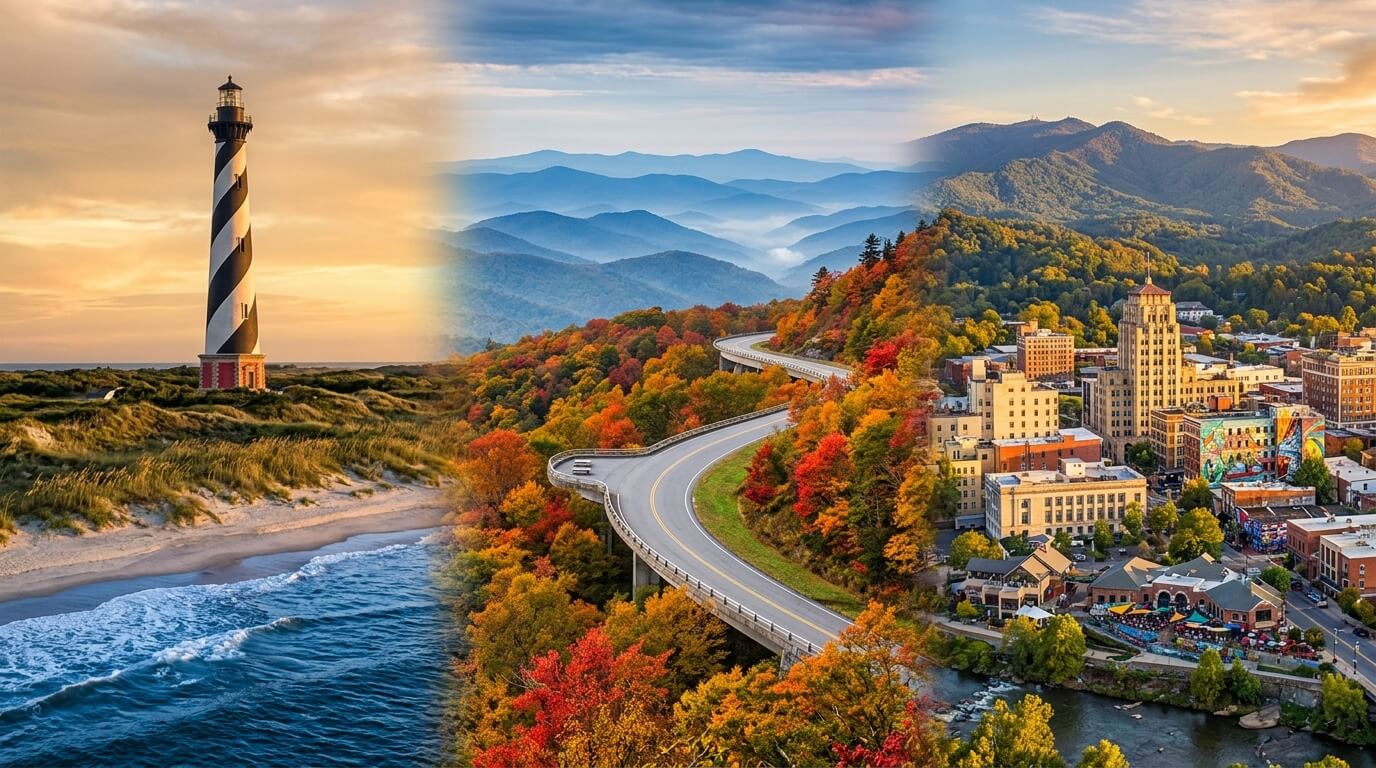
North Carolina runs from the Blue Ridge Mountains around Asheville all the way to the barrier islands of the Outer Banks, covering more ground and more contrast than almost any other state on the East Coast. Charlotte anchors the state as a banking and NASCAR hub, while Raleigh, Durham, and Chapel Hill make up the Research Triangle, one of the country's biggest concentrations of universities and tech jobs. In between, the Blue Ridge Parkway, Great Smoky Mountains, and 300 miles of coastline give visitors an entirely different state depending on which direction they head.
Top Attractions, Tours and Tickets in North Carolina
Asheville & the Blue Ridge Mountains
Asheville anchors western North Carolina's mountain scene, built around the Biltmore Estate, the largest privately-owned house in the United States, with 250 rooms, sprawling gardens, and its own winery on the grounds. The Blue Ridge Parkway, one of the most scenic drives in the country, runs along the ridgeline just outside the city, connecting dozens of overlooks and trailheads to waterfalls scattered through Pisgah National Forest. Downtown Asheville itself has grown into one of the South's biggest craft beer destinations, with dozens of breweries within a short walk of each other.
Book Blue Ridge Parkway Waterfalls Hiking TourThe Great Smoky Mountains
Great Smoky Mountains National Park straddles the North Carolina-Tennessee border, and the North Carolina side, reached through gateway towns like Bryson City and Cherokee, sees far fewer crowds than the Gatlinburg side while offering the same waterfalls, ridgeline views, and old-growth forest. Cherokee, home to the Eastern Band of the Cherokee Indians, sits right at the park's southern entrance and offers a very different cultural angle on the region than the Tennessee side. A guided waterfall hike from Bryson City is one of the more low-key ways to get into the park without the Gatlinburg traffic.
Book Bryson City Guided Waterfalls HikeThe Outer Banks
The Outer Banks are a chain of barrier islands stretching along North Carolina's northern coast, connected by bridges and a handful of ferries. Nags Head and neighboring Kill Devil Hills mark the spot where the Wright Brothers made the first powered flight in 1903, now preserved at the Wright Brothers National Memorial, while Jockey's Ridge State Park protects the tallest natural sand dune system on the East Coast. Farther south, Cape Hatteras National Seashore and its iconic black-and-white spiral lighthouse mark some of the wildest, least developed beaches on the entire Atlantic coast.
Book Bodie Island Clear Kayak TourCharlotte & NASCAR
Charlotte is the second-largest banking center in the country after New York, but it is just as closely tied to NASCAR, with the NASCAR Hall of Fame downtown and Charlotte Motor Speedway hosting some of the sport's biggest races each year in nearby Concord. Uptown Charlotte's skyline has grown rapidly around the city's banking headquarters, while the South End and NoDa neighborhoods have become the city's breweries-and-murals district. The U.S. National Whitewater Center, just outside the city, adds a rafting and zip-lining option not found in most other Southern downtowns.
Raleigh & the Research Triangle
Raleigh, Durham, and Chapel Hill make up the Research Triangle, anchored by North Carolina State University, Duke University, and the University of North Carolina, and built into one of the country's biggest hubs for biotech, tech, and university-driven research. Raleigh's downtown mixes the domed 1840 State Capitol with a growing food and brewery scene, and the North Carolina Museum of Natural Sciences and Museum of Art are both free to enter. A downtown walking tour is a good way to cover the historic core, from the Capitol grounds to the restored Victorian houses of the Oakwood neighborhood.
Book Raleigh Downtown Historic Walking TourWilmington & the Cape Fear Coast
Wilmington sits where the Cape Fear River meets the Atlantic, and its Riverwalk, lined with shops and restaurants in restored 19th-century warehouses, has made it one of the most walkable historic downtowns in the state. The Battleship North Carolina is permanently docked across the river and open for self-guided tours, and the city's film studio history, including work on Dawson's Creek and One Tree Hill, still draws production crews today. A short drive gets visitors to Wrightsville Beach, Carolina Beach, or the ferry to Bald Head Island, all quieter than the Outer Banks further north.
Book Wilmington Ghost TourThe Piedmont & State Parks
Between the mountains and the coast, North Carolina's Piedmont region covers most of the state's population and a scattering of underrated outdoor spots. Chimney Rock State Park, southeast of Asheville, offers a 315-foot granite spire reached by elevator with views over Lake Lure and Hickory Nut Gorge. Lake Norman, north of Charlotte, is the state's largest man-made lake and a popular summer boating destination, while Uwharrie National Forest, one of the oldest mountain ranges in the country, offers mountain biking and hiking closer to the Triad cities of Winston-Salem and Greensboro.
Major Cities and Places to Visit in North Carolina
- Charlotte Tours & Tickets - North Carolina's largest city and a major banking center, home to the NASCAR Hall of Fame, the Carolina Panthers, and a fast-growing Uptown skyline.
- Raleigh Tours & Tickets - North Carolina's state capital and the anchor of the Research Triangle, built around North Carolina State University and a walkable downtown.
- Asheville Tours & Tickets - A Blue Ridge Mountains arts city best known for the Biltmore Estate, a thriving craft brewery scene, and easy access to Pisgah National Forest.
- Wilmington Tours & Tickets - A historic port city on the Cape Fear River, known for its riverside downtown, the Battleship North Carolina, and nearby beaches.
- Durham Tours & Tickets - Home to Duke University and a revitalized downtown built around former tobacco warehouses, part of the Research Triangle alongside Raleigh and Chapel Hill.
- Winston-Salem Tours & Tickets - A Piedmont city built on the tobacco and textile industries, home to Old Salem's restored Moravian settlement and Wake Forest University.
- Greensboro Tours & Tickets - A central North Carolina city known for its Revolutionary War history at Guilford Courthouse and its role in the 1960 Greensboro sit-ins.
- Nags Head Tours & Tickets - The commercial hub of the northern Outer Banks, with some of the tallest sand dunes on the East Coast at Jockey's Ridge State Park.
Universities, Colleges and Sports Teams in North Carolina
- Duke University in Durham - Private research university in Durham, consistently ranked among the top universities in the country, with a nationally prominent basketball program.
- University of North Carolina at Chapel Hill - The state's flagship public research university, chartered in 1789 as the first public university in the country.
- North Carolina State University in Raleigh - A public land-grant research university in Raleigh, home of the NC State Wolfpack.
- Wake Forest University in Winston-Salem - A private research university in Winston-Salem known for its basketball program and law and medical schools.
- Carolina Panthers (sports team) in Charlotte - NFL franchise playing home games at Bank of America Stadium in Uptown Charlotte.
- Charlotte Hornets (sports team) in Charlotte - NBA franchise playing home games at the Spectrum Center in Uptown Charlotte.
- Carolina Hurricanes (sports team) in Raleigh - NHL franchise playing home games at Lenovo Center in Raleigh.
North Carolina Demographics and Population
According to the 2024 American Community Survey, North Carolina has a population of approximately 11,046,024 people across 48,624 square miles, ranking it 9th among U.S. states by population. The median household income is $73,958, and the largest racial and ethnic groups are Asian (3.9%), White (59.9%), Hispanic Latino (12%), American Indian and Alaska Native (1%), and Black or African American (20.8%). The median age is 39.4 years, and the per capita income is $42,777. Approximately 12.5% of residents live below the poverty line, compared to the national rate of 12.5%. North Carolina has 4,496,359 households and a mean commute time of 25.7 minutes. North Carolina's economy blends Charlotte's role as the country's second-largest banking center after New York, the Research Triangle's biotech and tech industries anchored by Duke, UNC, and NC State, and a long agricultural tradition in tobacco, hogs, and sweet potatoes.
When to Visit North Carolina
Winter (December through February): Mild in the Piedmont and coastal Wilmington area, but with real snow and cold possible at higher Blue Ridge elevations around Asheville. Spring (March through May): Warm and colorful, with dogwoods and azaleas blooming across the Piedmont and mountain wildflowers appearing by late April. Summer (June through August): Hot and humid across the Piedmont and coast, with the Outer Banks and mountain towns like Asheville offering cooler relief from the heat. Fall (September through November) is the best time to visit North Carolina. Mild temperatures and vivid foliage in the Blue Ridge Mountains, especially along the Blue Ridge Parkway around Asheville, typically peaking in mid-to-late October.
Frequently Asked Questions About Touring North Carolina
Official North Carolina Resources
The following official government websites provide additional planning resources, park information, and historical records for travelers visiting North Carolina.
| Resource | Description | Website |
|---|---|---|
| Visit North Carolina | The state's official travel and tourism site with attraction guides, events, and trip planning tools. | www.visitnc.com/ |
| North Carolina State Parks | Official listing of state parks and recreation areas, including Chimney Rock and Jockey's Ridge. | www.ncparks.gov/ |
| State Archives of North Carolina | State agency responsible for preserving historical government records and documents for research and genealogy. | archives.ncdcr.gov/ |
| NC Department of Natural and Cultural Resources | State agency overseeing museums, historic sites, and archives across North Carolina. | www.dncr.nc.gov/ |
| NC.gov | The official portal for North Carolina state government services and information. | www.nc.gov/ |