Last updated August 17, 2026
The Best Tours & Places to Visit in Oklahoma
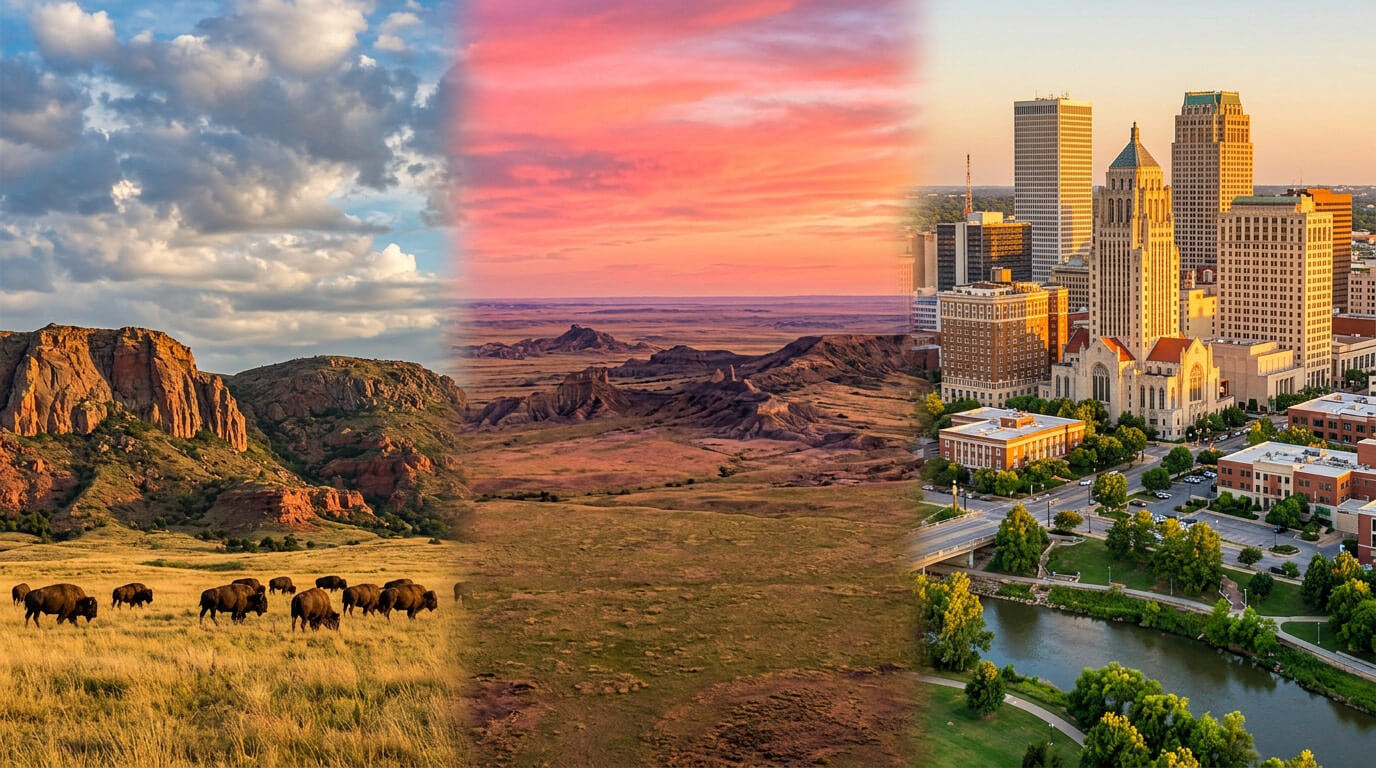
Oklahoma sits at the crossroads of the Great Plains, the Ozarks, and Native America, home to 39 federally recognized tribal nations and more tribal headquarters than any other state in the country. Oklahoma City and Tulsa anchor the state with very different personalities, one built around a national memorial and cowboy culture, the other around early-20th-century oil wealth and one of the country's largest concentrations of Art Deco architecture. Beyond the cities, a stretch of the original Route 66 still runs across the state, and the Arbuckle and Ouachita Mountains in the south offer a hillier, greener side of Oklahoma most visitors don't expect.
Top Attractions, Tours and Tickets in Oklahoma
Oklahoma City: Bricktown & the Memorial
Oklahoma City centers on Bricktown, a former warehouse district turned entertainment strip along a walkable canal, and the Oklahoma City National Memorial & Museum, which honors the 168 people killed in the 1995 bombing of the Alfred P. Murrah Federal Building with a field of empty bronze chairs and a reflecting pool where the building once stood. Scissortail Park, a 70-acre green space connecting downtown to the Oklahoma River, and the Myriad Botanical Gardens' glass Crystal Bridge conservatory round out the city's recent downtown investment. A streetcar hop-on hop-off route is an easy way to link Bricktown, downtown, and the Memorial without driving between them.
Book OKC Streetcar Hop-On Hop-Off TourTulsa & Art Deco Architecture
Oil wealth from the early 20th-century boom turned Tulsa into one of the best places in the country to see Art Deco architecture, with buildings like the Boston Avenue Methodist Church and the Philcade Building showing off the style's geometric ornamentation and terra cotta detailing. The Philbrook Museum of Art, set in a 1920s Italianate villa and gardens, and the riverside Gathering Place, consistently ranked among the best public parks in the country, both add to a downtown that has been steadily reinvesting for the past decade. A guided walking tour is the best way to actually learn what you're looking at while covering the compact downtown core on foot.
Book Tulsa Art Deco Walking TourCowboy & Western Heritage
The National Cowboy & Western Heritage Museum in Oklahoma City holds more than 28,000 pieces of Western and Native American art and artifacts, including a rotunda anchored by James Earle Fraser's "End of the Trail" sculpture. Just west of downtown, Stockyards City still operates around the country's largest stocker and feeder cattle market, with working Western wear shops and Cattlemen's Steakhouse, in continuous operation since 1910, serving the neighborhood's signature lamb fries and steaks. The combination of a serious museum and a genuinely working stockyard district gives Oklahoma City a Western heritage angle that feels lived-in rather than staged for tourists.
Native American Heritage & Tribal Nations
Oklahoma is home to 39 federally recognized tribal nations, more than any other state, a legacy of the forced relocations of the 19th century that brought the Cherokee, Choctaw, Chickasaw, Muscogee, and Seminole Nations, among many others, onto what was then designated Indian Territory. The First Americans Museum in Oklahoma City, which opened in 2021, tells the shared history and individual stories of all 39 tribal nations through one institution, while the Chickasaw Cultural Center near Sulphur focuses specifically on Chickasaw history, language, and living culture across a 184-acre campus. Tribal nations across the state also operate their own museums, casinos, and cultural centers, making Native American heritage one of the most substantial and ongoing parts of Oklahoma's identity rather than a historical footnote.
Route 66 in Oklahoma
Oklahoma carries the longest drivable stretch of the original Route 66 of any state, more than 400 miles running from the Kansas border through Tulsa and Oklahoma City down to Texas. The route passes roadside icons like the Blue Whale of Catoosa, a hand-built swimming hole attraction from the 1970s, the leaning Route 66 water tower in Tulsa, and the neon-lit Rock Cafe in Stroud, which has been serving travelers since 1939. The Oklahoma Route 66 Museum in Clinton covers the highway's full history decade by decade, from its Dust Bowl-era origins to its decline after the interstate system replaced it.
Turner Falls & the Arbuckle Mountains
Turner Falls, a 77-foot waterfall in the Arbuckle Mountains near Davis, is Oklahoma's most-visited natural swimming spot, with a spring-fed pool at the base of the falls that stays cool through the height of summer. The surrounding Arbuckle Mountains, among the oldest exposed mountain ranges in North America, offer hiking and cave exploration at places like the Chickasaw National Recreation Area near Sulphur, a genuinely different landscape from the flat plains found through most of central and western Oklahoma.
Tallgrass Prairie & the Great Plains
The Tallgrass Prairie Preserve in Osage County protects nearly 40,000 acres of native tallgrass prairie, one of the last large remnants of an ecosystem that once covered 140 million acres of North America, complete with a free-roaming bison herd reintroduced in 1993. Farther west, the Black Mesa area in Oklahoma's panhandle reaches the state's highest point at 4,973 feet and sits closer to Colorado and New Mexico than to Oklahoma City, giving it a high-desert feel unlike anywhere else in the state. Both areas reward travelers willing to drive well off the interstate for genuinely open, empty landscapes.
Major Cities and Places to Visit in Oklahoma
- Oklahoma City Tours & Tickets - Oklahoma's state capital and largest city, home to Bricktown's entertainment district, the Oklahoma City National Memorial, and the National Cowboy & Western Heritage Museum.
- Tulsa Tours & Tickets - Oklahoma's second-largest city, built on early 20th-century oil wealth and known for one of the largest concentrations of Art Deco architecture in the country.
- Norman Tours & Tickets - A college town south of Oklahoma City, home to the University of Oklahoma and a walkable historic Main Street.
- Stillwater Tours & Tickets - Home to Oklahoma State University, a north-central Oklahoma college town built around Boone Pickens Stadium and a lively college-town food scene.
- Bartlesville Tours & Tickets - A northeastern Oklahoma city shaped by early oil wealth, home to Frank Lloyd Wright's only realized skyscraper, Price Tower.
- Sulphur Tours & Tickets - A south-central Oklahoma town within Chickasaw National Recreation Area, home to the Chickasaw Cultural Center and mineral springs.
- Guthrie Tours & Tickets - Oklahoma's first state capital, preserved today as one of the largest urban historic districts in the country with intact Victorian-era architecture.
- Broken Bow Tours & Tickets - A southeastern Oklahoma town in the Ouachita Mountains, the gateway to Beavers Bend State Park and a major cabin-rental destination.
Universities, Colleges and Sports Teams in Oklahoma
- University of Oklahoma in Norman - The state's flagship public research university in Norman, home of the Oklahoma Sooners.
- Oklahoma State University in Stillwater - A public land-grant research university in Stillwater, home of the Oklahoma State Cowboys.
- Oklahoma City Thunder (sports team) in Oklahoma City - NBA franchise playing home games at Paycom Center in downtown Oklahoma City.
Oklahoma Demographics and Population
According to the 2024 American Community Survey, Oklahoma has a population of approximately 4,095,393 people across 68,597 square miles, ranking it 28th among U.S. states by population. The median household income is $65,039, and the largest racial and ethnic groups are Asian (3%), White (72.6%), Hispanic Latino (10.1%), American Indian and Alaska Native (9.6%), and Black or African American (7.9%). The median age is 37.4 years, and the per capita income is $35,882. Approximately 14.9% of residents live below the poverty line, compared to the national rate of 12.5%. Oklahoma has 1,603,748 households and a mean commute time of 22.7 minutes. Oklahoma's economy is built on oil and natural gas production, agriculture including wheat and cattle, and aviation manufacturing anchored by Tinker Air Force Base in Oklahoma City, alongside a growing tribal gaming and tourism industry tied to the state's 39 federally recognized tribal nations.
When to Visit Oklahoma
Winter (December through February): Cold with occasional ice storms, generally milder than states farther north but still capable of sharp cold snaps. Spring (March through May): Oklahoma's severe weather season, with tornadoes possible from March through June, though wildflowers and mild temperatures make it a beautiful season between storm systems. Summer (June through August): Hot and humid, the best season for Turner Falls and the lakes of the Arbuckle and Ouachita Mountains. Fall (September through November) is the best time to visit Oklahoma. Mild and generally the most pleasant season statewide, with foliage in the southeastern mountains, college football season, and far less severe weather risk than spring.
Frequently Asked Questions About Touring Oklahoma
Official Oklahoma Resources
The following official government websites provide additional planning resources, park information, and historical records for travelers visiting Oklahoma.
| Resource | Description | Website |
|---|---|---|
| TravelOK.com | The state's official travel and tourism site with attraction guides, events, and trip planning tools. | www.travelok.com/ |
| Oklahoma State Parks | Official listing of the state's 38 state parks, including Turner Falls-area sites and Beavers Bend State Park. | www.travelok.com/state-parks |
| Oklahoma Historical Society | State agency responsible for historic sites, museums, and archival research and genealogy resources. | www.okhistory.org/ |
| OK.gov | The official portal for Oklahoma state government services and information. | oklahoma.gov/ |