Last updated August 17, 2026
The Best Tours & Places to Visit in Pennsylvania
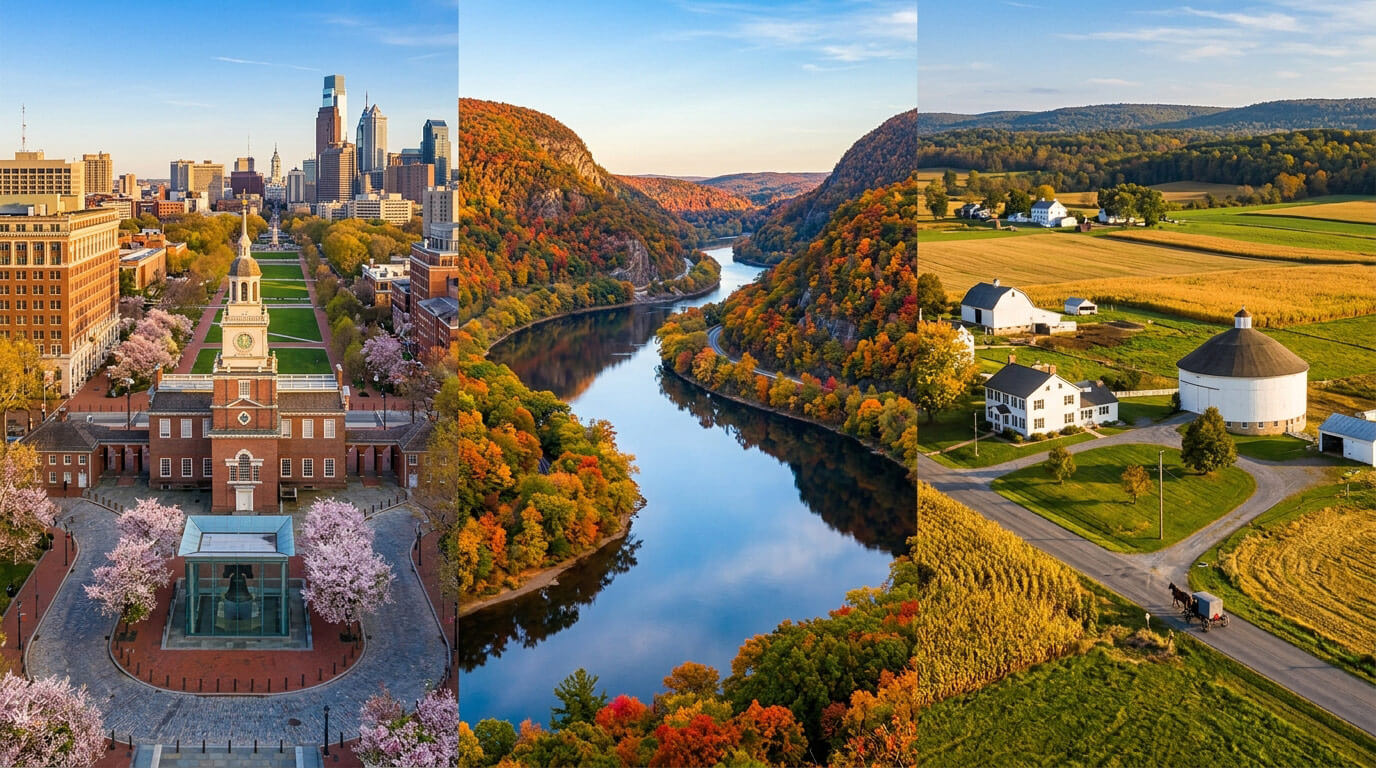
Pennsylvania anchors the birth of the United States, from Independence Hall and the Liberty Bell in Philadelphia to the bloodiest single battle of the Civil War at Gettysburg. Pittsburgh, on the opposite side of the state, has reinvented itself from a steel town into a technology and healthcare hub built around three rivers and dozens of bridges. In between, the Amish farmland of Lancaster County, the chocolate-scented streets of Hershey, and the wooded ridges of the Poconos give Pennsylvania a rural, small-town character that most visitors passing through on the interstate never see.
Top Attractions, Tours and Tickets in Pennsylvania
Philadelphia & Independence Mall
Philadelphia's Independence Mall concentrates more early American history into a few blocks than almost anywhere else in the country. Independence Hall, where both the Declaration of Independence and the Constitution were debated and signed, sits directly across from the Liberty Bell, cracked and retired from public ringing since the 1840s but still one of the most recognizable symbols of American independence. The surrounding blocks also hold Christ Church, where several founding fathers worshipped, and the reconstructed site of the President's House, which addresses the enslaved people George Washington held there while serving as president.
Book Independence Mall Walking TourAmish Country & Lancaster County
Lancaster County is the heart of Pennsylvania Dutch Country, home to one of the oldest and largest Amish communities in the country, still farming much of the surrounding land with horse-drawn equipment. The Central Market in downtown Lancaster, operating continuously since the 1730s, remains the oldest publicly owned farmers market in the country, and towns like Bird-in-Hand and Intercourse anchor a landscape of covered bridges, quilt shops, and family-run bakeries. A guided visit to an Amish farm and a home-cooked meal offers a far more genuine look at the community than driving past roadside stands alone.
Book Lancaster County Amish Family Tour & MealGettysburg & the Civil War
The Battle of Gettysburg, fought over three days in July 1863, remains the bloodiest single battle of the Civil War, with roughly 51,000 combined casualties and a Confederate defeat that marked a turning point in the war. Gettysburg National Military Park now preserves more than 6,000 acres of the battlefield with over 1,300 monuments and markers, and the Gettysburg National Cemetery, dedicated by Abraham Lincoln's brief but famous Gettysburg Address later that year, sits adjacent to the battlefield itself. The small town of Gettysburg has grown its own tourism economy around the battle, with museums, bookstores, and guided walking tours covering different angles of the three-day fight.
Book Secrets of Gettysburg Walking TourPittsburgh & the Three Rivers
Pittsburgh sits at the confluence of the Allegheny and Monongahela Rivers, which merge to form the Ohio River directly at Point State Park, and the city's 446 bridges give it more bridges than any city in the world besides Venice. The Duquesne Incline, a Victorian-era cable car still running up Mount Washington, delivers one of the best skyline views in the country, especially at night when the Point State Park fountain and the confluence of all three rivers are lit up below. Once defined almost entirely by steel manufacturing, Pittsburgh has rebuilt its economy around Carnegie Mellon University, robotics, and healthcare over the past few decades.
Hershey & Chocolate Country
Hershey grew directly out of Milton Hershey's chocolate factory, and the town still carries the theme down to its chocolate-kiss-shaped streetlights on Chocolate Avenue. Hersheypark combines a full amusement park, water park, and an 11-acre zoo on one property, while Hershey's Chocolate World, at the entrance to the park, offers a free factory-tour-style ride explaining how chocolate is made. The Hershey Story Museum digs into founder Milton Hershey's life and the company town he built for his workers, a rare example of early-20th-century industrial planning still functioning as a real town today.
The Pocono Mountains
The Poconos, a forested plateau in northeastern Pennsylvania, have drawn vacationers from New York and Philadelphia since the early 20th century, first as a honeymoon destination known for heart-shaped bathtubs and later as a four-season outdoor destination. Bushkill Falls, marketed as the "Niagara of Pennsylvania," is actually a series of eight waterfalls connected by boardwalk trails, and the Delaware Water Gap National Recreation Area straddles the Pennsylvania-New Jersey border along the Delaware River with hiking, rafting, and river tubing. Ski resorts across the region keep the Poconos busy through winter as well, giving the area a longer season than most nearby mountain destinations.
Pennsylvania's State Parks & Wilds
Ricketts Glen State Park, in the state's northeast, packs 22 named waterfalls into a single loop trail through old-growth forest, one of the most concentrated waterfall hikes in the eastern United States. Near Erie, Presque Isle State Park curves seven miles into Lake Erie, offering sandy freshwater beaches that feel more like the ocean than a Great Lake. Farther north, the Pennsylvania Grand Canyon, cut by Pine Creek through Tioga State Forest, reaches depths of nearly 1,000 feet and anchors the sparsely populated region locals call the "Pennsylvania Wilds."
Major Cities and Places to Visit in Pennsylvania
- Philadelphia Tours & Tickets - Pennsylvania's largest city and the birthplace of American independence, home to Independence Hall, the Liberty Bell, and a nationally famous cheesesteak scene.
- Pittsburgh Tours & Tickets - A former steel city rebuilt around technology and healthcare, set at the confluence of three rivers with one of the most dramatic skyline views in the country from Mount Washington.
- Harrisburg Tours & Tickets - Pennsylvania's state capital on the Susquehanna River, home to a Beaux-Arts State Capitol building modeled partly on St. Peter's Basilica.
- Lancaster Tours & Tickets - The heart of Pennsylvania Dutch Country, surrounded by Amish farmland and home to the country's oldest continuously operating farmers market.
- Hershey Tours & Tickets - A company town built around Milton Hershey's chocolate empire, home to Hersheypark and the aroma of chocolate that still drifts through downtown.
- Gettysburg Tours & Tickets - The site of the Civil War's bloodiest battle, preserved today as Gettysburg National Military Park with more than 1,300 monuments across the battlefield.
- Allentown Tours & Tickets - A Lehigh Valley city that shifted from steel manufacturing to a diversified economy, within easy reach of both Philadelphia and the Poconos.
- Erie Tours & Tickets - A Lake Erie port city known for Presque Isle State Park, a sandy peninsula with some of the best freshwater beaches in the country.
Universities, Colleges and Sports Teams in Pennsylvania
- University of Pennsylvania in Philadelphia - Ivy League research university founded in 1740, one of the nine Colonial Colleges, with its campus in West Philadelphia.
- Penn State University - The state's flagship public research university, based in University Park, with one of the largest alumni networks and college football followings in the country.
- Carnegie Mellon University in Pittsburgh - A private research university in Pittsburgh known for computer science, robotics, and the arts, central to the city's economic reinvention.
- Philadelphia Eagles (sports team) in Philadelphia - NFL franchise playing home games at Lincoln Financial Field in South Philadelphia.
- Philadelphia Phillies (sports team) in Philadelphia - MLB franchise playing home games at Citizens Bank Park, representing one of the oldest continuous franchises in professional sports.
- Pittsburgh Steelers (sports team) in Pittsburgh - NFL franchise playing home games at Acrisure Stadium, with six Super Bowl titles among the most of any NFL team.
- Pittsburgh Penguins (sports team) in Pittsburgh - NHL franchise playing home games at PPG Paints Arena in downtown Pittsburgh.
Pennsylvania Demographics and Population
According to the 2024 American Community Survey, Pennsylvania has a population of approximately 13,002,700 people across 44,742 square miles, ranking it 5th among U.S. states by population. The median household income is $77,545, and the largest racial and ethnic groups are Asian (4.4%), White (73.2%), Hispanic Latino (9.4%), American Indian and Alaska Native (0.1%), and Black or African American (10.8%). The median age is 41.2 years, and the per capita income is $44,674. Approximately 11.6% of residents live below the poverty line, compared to the national rate of 12.5%. Pennsylvania has 5,361,724 households and a mean commute time of 27.1 minutes. Pennsylvania's economy blends Philadelphia's healthcare, education, and finance sectors, Pittsburgh's shift from steel manufacturing into technology and robotics research anchored by Carnegie Mellon, and significant natural gas production from the Marcellus Shale in the state's north and west.
When to Visit Pennsylvania
Winter (December through February): Cold with regular snow, heaviest in the Poconos and around Erie, where lake-effect snow off Lake Erie can be significant. Spring (March through May): Mild and blooming, with the Philadelphia Flower Show in early March kicking off the season. Summer (June through August) is the best time to visit Pennsylvania. Warm and the peak season for Hersheypark, the Poconos, and Gettysburg, which draws especially large crowds around the battle anniversary in early July. Fall (September through November): Cool and colorful, with strong foliage across the Poconos and Pennsylvania Wilds alongside Lancaster County's harvest season.
Frequently Asked Questions About Touring Pennsylvania
Official Pennsylvania Resources
The following official government websites provide additional planning resources, park information, and historical records for travelers visiting Pennsylvania.
| Resource | Description | Website |
|---|---|---|
| Visit PA | The state's official travel and tourism site with attraction guides, events, and trip planning tools. | www.visitpa.com/ |
| Pennsylvania State Parks | Official listing of state parks and forests, including Ricketts Glen and Presque Isle, run by the Department of Conservation and Natural Resources. | www.pa.gov/agencies/dcnr.html |
| Pennsylvania State Archives | State agency responsible for preserving historical government records and documents for research and genealogy. | www.pa.gov/agencies/phmc/pa-state-archives |
| PA.gov | The official portal for Pennsylvania state government services and information. | www.pa.gov/ |