Last updated August 17, 2026
The Best Tours & Places to Visit in Rhode Island
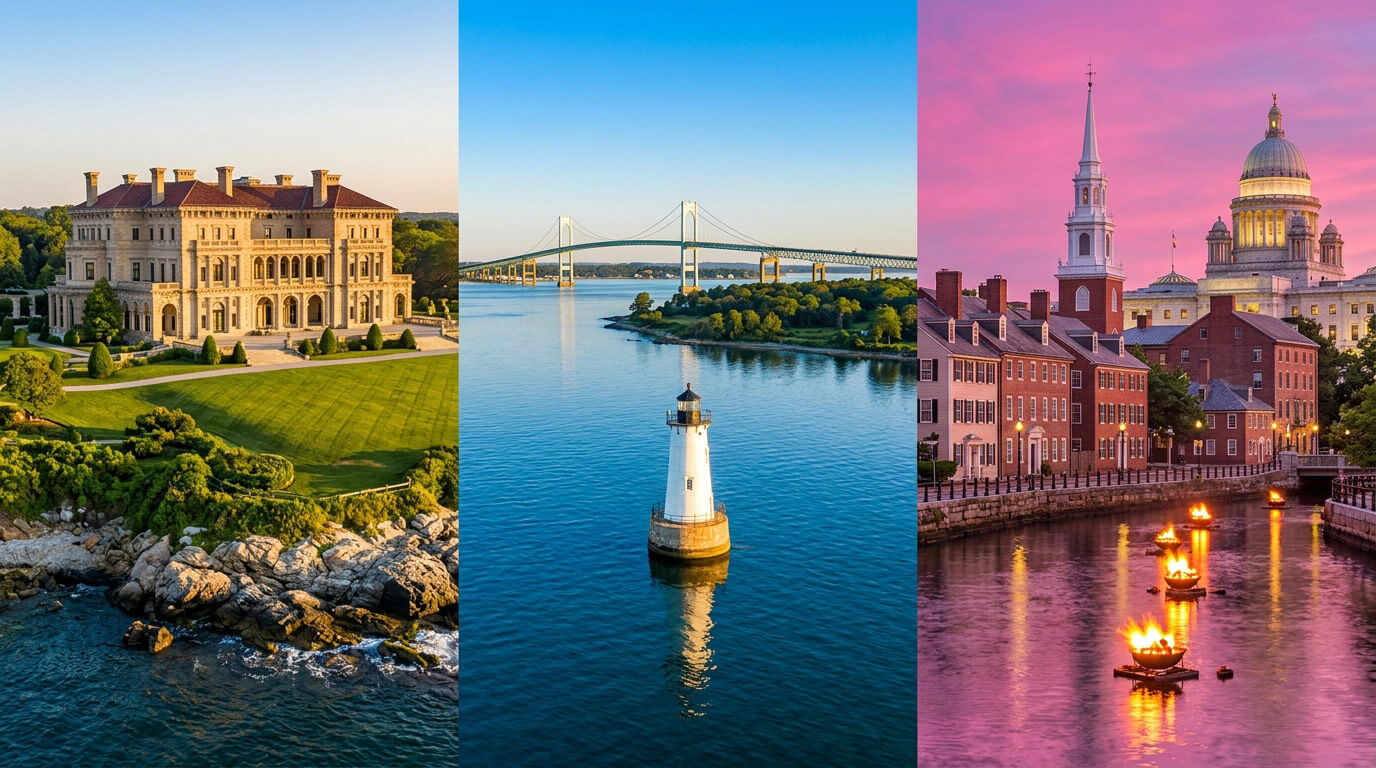
Rhode Island packs an outsized amount of history and coastline into the smallest state in the country, from the Gilded Age mansions of Newport to Providence's twice-monthly WaterFire installation along its downtown rivers. Narragansett Bay cuts deep into the state, giving nearly every part of Rhode Island easy access to water, and Block Island, twelve miles offshore, adds a genuinely remote escape reachable only by ferry or small plane. Its small size is a practical advantage for visitors: nowhere in Rhode Island is more than about an hour from anywhere else.
Top Attractions, Tours and Tickets in Rhode Island
Newport's Gilded Age Mansions
Newport became the summer capital of America's wealthiest families in the late 19th century, and the "cottages" they built along Bellevue Avenue remain some of the most extravagant private homes ever constructed in the country. The Breakers, built for Cornelius Vanderbilt II as a 70-room Italian Renaissance-style palazzo, is the grandest of the group, while Marble House and The Elms round out the most-visited properties, each preserved and operated by the Preservation Society of Newport County. Most mansions can be visited individually or combined on a single multi-property ticket for visitors who want to see more than one in a day.
Book Newport Mansions TicketNewport's Cliff Walk & Sailing Heritage
The Cliff Walk, a 3.5-mile public trail running along Newport's Atlantic-facing shoreline, threads directly behind the backyards of the Gilded Age mansions, giving pedestrians ocean views the original owners built their homes around. Newport's sailing pedigree goes back even further, as home to the America's Cup for more than 50 years and still one of the most active sailing harbors on the East Coast, with tall ships and classic wooden yachts a regular sight in the harbor. A scenic trolley tour is an easy way to see the mansion district, the harbor, and the Cliff Walk without needing to find parking at each stop.
Book Newport Scenic Trolley TourProvidence & WaterFire
Providence's signature event, WaterFire, has drawn crowds to the city's downtown rivers since 1994, when nearly 100 bonfires are lit just above the water's surface along a torch-lit path through Waterplace Park and the Providence River, accompanied by music and silent boats gliding between the flames. Outside of WaterFire nights, which run on select Saturdays from May through November, Providence's compact downtown mixes Brown University and the Rhode Island School of Design with Federal Hill, the city's Italian-American neighborhood, still packed with red-sauce restaurants and bakeries.
Block Island
Block Island, reachable by ferry from Point Judith, Newport, or nearby Connecticut and New York ports, keeps a noticeably slower pace than the mainland, with no traffic lights and a landscape of rolling moraine hills left behind by the last ice age. Mohegan Bluffs, reached by a 141-step staircase, drops 150 feet to a narrow beach beneath dramatic clay cliffs, and two historic lighthouses, Southeast Light and North Light, bookend the island. Renting a bike at the ferry landing is the standard way to get around, with the full loop road covering roughly 16 miles past the island's beaches and farmland.
Narragansett Bay & the Rhode Island Coast
Narragansett Bay cuts deep into Rhode Island, splitting the state into a series of peninsulas and islands connected by bridges, and its shoreline supports beach towns from Watch Hill in the southwest to Bristol on the bay's eastern shore. Narragansett Town Beach and Scarborough State Beach anchor South County's beach scene, both consistently ranked among the best beaches in New England, while Beavertail State Park, on the southern tip of Jamestown, offers dramatic rocky coastline and a working lighthouse rather than sand. The bay itself remains a working waterway too, with commercial fishing fleets still operating out of Galilee and Point Judith alongside the recreational sailors.
Colonial & Native Heritage
Rhode Island was founded in 1636 by Roger Williams after his banishment from the Massachusetts Bay Colony over his advocacy for religious freedom and separation of church and state, principles that shaped the colony's unusually tolerant founding compared to its Puritan neighbors. Providence's First Baptist Church in America, founded by Williams in 1638, still holds services in its 1775 meetinghouse. The Narragansett Indian Tribe, the state's only federally recognized tribal nation, maintains a longhouse and tribal lands in Charlestown, and its annual August Meeting powwow, held for more than 300 years, remains one of the oldest continuous Native American gatherings in the country.
State Parks & Outdoor Rhode Island
Colt State Park, on the shore of Narragansett Bay in Bristol, combines open meadows, a shoreline bike path, and views across the bay in one of the most popular state parks in Rhode Island. Arcadia Management Area, the largest single block of protected land in the state at nearly 14,000 acres, offers a genuinely wooded, hilly landscape more reminiscent of inland New England than the coastal image most visitors have of Rhode Island. The East Bay Bike Path, running 14.5 miles between Providence and Bristol along a former rail line, is one of the most popular multi-use trails in the state.
Major Cities and Places to Visit in Rhode Island
- Providence Tours & Tickets - Rhode Island's capital and largest city, home to Brown University, the Rhode Island School of Design, and the twice-monthly WaterFire art installation on its downtown rivers.
- Newport Tours & Tickets - A historic sailing city on Narragansett Bay, famous for Gilded Age mansions built as summer "cottages" by families like the Vanderbilts.
- Warwick Tours & Tickets - Rhode Island's second-largest city, home to T.F. Green International Airport and miles of Narragansett Bay shoreline.
- Woonsocket Tours & Tickets - A former mill city in northern Rhode Island along the Blackstone River, shaped by 19th-century French-Canadian textile workers.
- Pawtucket Tours & Tickets - An early center of the American Industrial Revolution, home to the Slater Mill, the country's first successful water-powered cotton spinning mill.
- Westerly Tours & Tickets - A southwestern Rhode Island town on the Connecticut border, home to the beach village of Watch Hill and its historic 1876 Flying Horse Carousel.
- Bristol Tours & Tickets - A Narragansett Bay town known for hosting the country's oldest continuous Fourth of July celebration, dating to 1785.
- Block Island Tours & Tickets - A small island twelve miles off the Rhode Island coast, reachable only by ferry or small plane, known for the Mohegan Bluffs and two historic lighthouses.
Universities, Colleges and Sports Teams in Rhode Island
- Brown University in Providence - Ivy League research university founded in 1764, one of the nine Colonial Colleges, known for its flexible open curriculum.
- Rhode Island School of Design in Providence - One of the most selective and highly regarded art and design schools in the country, adjacent to the Brown University campus.
- Providence Bruins (sports team) in Providence - The Boston Bruins' AHL affiliate, playing home games at the Amica Mutual Pavilion in downtown Providence.
Rhode Island Demographics and Population
According to the 2024 American Community Survey, Rhode Island has a population of approximately 1,101,801 people across 1,045 square miles, ranking it 45th among U.S. states by population. The median household income is $87,796, and the largest racial and ethnic groups are Asian (3.5%), White (68%), Hispanic Latino (17.7%), American Indian and Alaska Native (1%), and Black or African American (4.9%). The median age is 41.0 years, and the per capita income is $47,260. Approximately 11.2% of residents live below the poverty line, compared to the national rate of 12.4%. Rhode Island has 448,318 households and a mean commute time of 26.3 minutes. Rhode Island's compact economy is built around healthcare, marine and boat manufacturing tied to Narragansett Bay, higher education anchored by Brown University and the Rhode Island School of Design, and a tourism industry driven heavily by Newport's Gilded Age mansions and sailing culture.
When to Visit Rhode Island
Winter (December through February): Cold and coastal, with Newport and Block Island both quiet and many seasonal attractions closed until spring. Spring (March through May): Mild with sailing season getting underway in Narragansett Bay and the first WaterFire lightings of the year in May. Summer (June through August) is the best time to visit Rhode Island. Warm and the peak season for Newport, Block Island, and South County's beaches, with WaterFire running regularly through the summer. Fall (September through November): Cool and colorful, with WaterFire continuing into November and noticeably thinner crowds at the Newport mansions.
Frequently Asked Questions About Touring Rhode Island
Official Rhode Island Resources
The following official government websites provide additional planning resources, park information, and historical records for travelers visiting Rhode Island.
| Resource | Description | Website |
|---|---|---|
| Visit Rhode Island | The state's official travel and tourism site with attraction guides, events, and trip planning tools. | www.visitrhodeisland.com/ |
| Rhode Island State Parks | Official listing of state parks and beaches, including Colt State Park and Beavertail State Park. | riparks.ri.gov/ |
| Rhode Island State Archives | State agency responsible for preserving historical government records and documents for research and genealogy. | www.sos.ri.gov/divisions/state-archives |
| RI.gov | The official portal for Rhode Island state government services and information. | www.ri.gov/ |