Last updated August 17, 2026
The Best Tours & Places to Visit in South Dakota
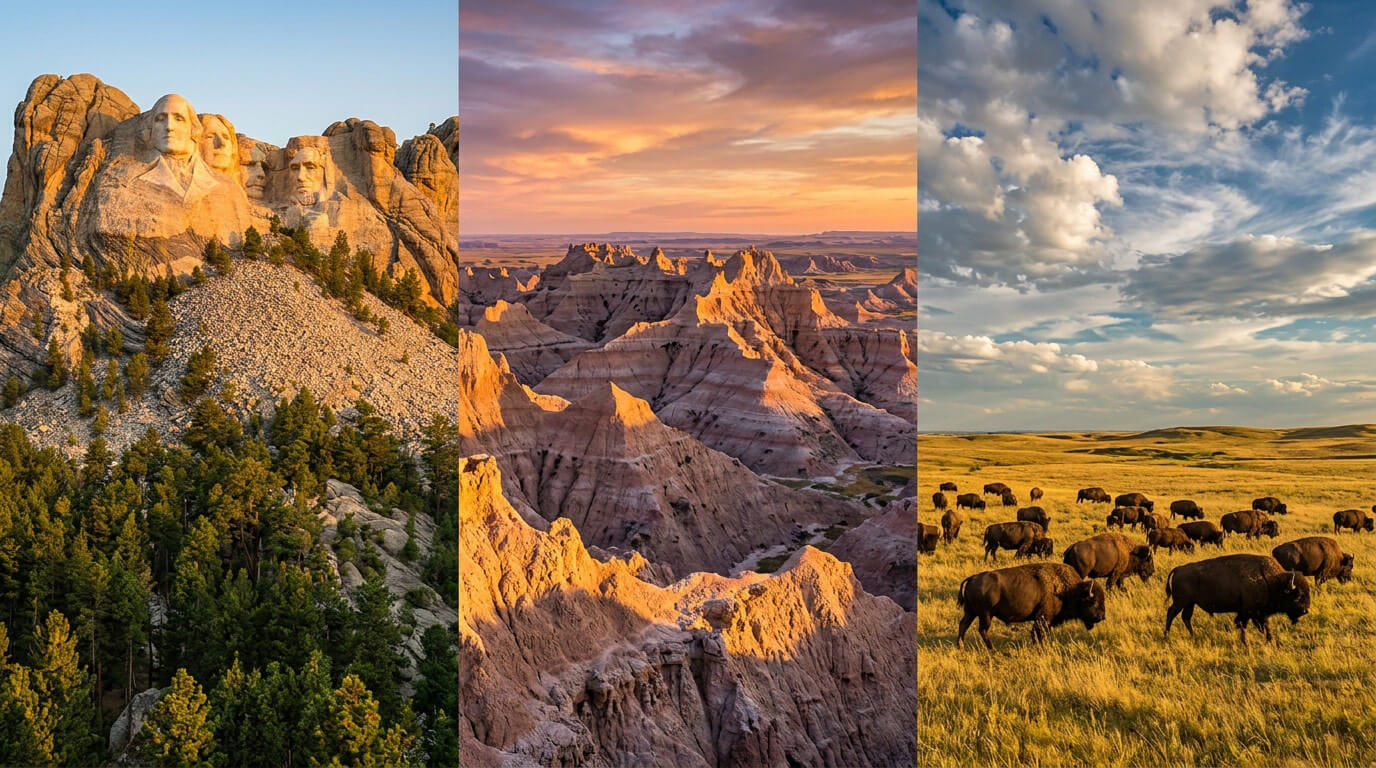
South Dakota packs some of the most recognizable landmarks in the American West into its far western corner, from the granite presidents of Mount Rushmore to the eroded spires of Badlands National Park. The Black Hills, sacred to the Lakota Sioux long before Mount Rushmore existed, hold Custer State Park's free-roaming bison herds, the still-unfinished Crazy Horse Memorial, and the Wild West gold rush town of Deadwood. Eastern South Dakota, anchored by Sioux Falls, looks almost nothing like the Black Hills, trading rugged buttes for the flat farmland of the Great Plains.
Top Attractions, Tours and Tickets in South Dakota
Mount Rushmore & the Black Hills
Mount Rushmore National Memorial, carved between 1927 and 1941 under sculptor Gutzon Borglum, depicts the 60-foot faces of Washington, Jefferson, Theodore Roosevelt, and Lincoln on a granite face in the Black Hills. The Presidential Trail loops directly beneath the sculpture for close-up views, and the Lincoln Borglum Museum covers the carving's engineering and history in detail. Just southwest, the Crazy Horse Memorial has been under construction since 1948 and, once finished, will be the largest sculpture in the world, honoring the Lakota leader who helped defeat Custer at Little Bighorn.
Book Mount Rushmore, Crazy Horse & Custer State Park TourBadlands National Park
Badlands National Park protects more than 240,000 acres of eroded buttes, pinnacles, and spires striped in shades of tan, red, and gold, formed by millions of years of sediment deposits and erosion. The Badlands Loop Road runs directly through the park with dozens of overlooks requiring little to no hiking, and the park also holds one of the richest fossil beds in the world, with saber-toothed cat and rhinoceros fossils still being excavated. Bison, bighorn sheep, and prairie dog towns are all common sights along the park's trails and pull-offs, giving the Badlands a genuinely wild feel despite the easy road access.
Book Badlands National Park Private TourDeadwood & the Black Hills Gold Rush
Deadwood sprang up almost overnight after gold was confirmed in the Black Hills in 1874, quickly filling with prospectors, saloons, and the kind of lawlessness later dramatized in film and television. Wild Bill Hickok was shot and killed here in 1876 while playing poker, and both he and Calamity Jane are buried side by side at Mount Moriah Cemetery, overlooking the town. Deadwood's entire downtown is now a National Historic Landmark, with restored Victorian buildings housing casinos, saloons, and museums covering the town's gold rush history in detail.
Book Deadwood Wild West Walking TourSioux Falls & Eastern South Dakota
Sioux Falls, South Dakota's largest city by a wide margin, is built directly around Falls Park, where the Big Sioux River drops 100 feet over pink Sioux quartzite outcrops in the middle of the city. The Old Courthouse Museum and the nearby Pettigrew Home & Museum cover the region's pioneer history, while South Dakota's lack of a state income tax has helped Sioux Falls grow into a regional hub for banking and credit card processing. Eastern South Dakota beyond Sioux Falls trades the Black Hills' dramatic scenery for flat, productive farmland and small agricultural towns.
Book Sioux Falls Ghost TourCuster State Park & Wildlife
Custer State Park, at nearly 71,000 acres, is home to one of the largest publicly held bison herds in the world, with roughly 1,300 animals roaming freely along the park's Wildlife Loop Road. Needles Highway and the Iron Mountain Road, both built in the 1920s, wind through granite spires and narrow tunnels deliberately aligned to frame Mount Rushmore in the distance, making the drive itself one of the park's main attractions. Every fall, the park's Buffalo Roundup draws thousands of spectators to watch cowboys and cowgirls herd the entire bison population together for their annual health checks.
Native American Heritage & the Reservations
South Dakota is home to nine Native American reservations, including Pine Ridge and Rosebud, both belonging to the Oglala and Sicangu Lakota Sioux, making up some of the largest reservations in the country by land area. The Black Hills themselves, known as Paha Sapa in Lakota, are sacred ground central to Lakota spirituality, and the ongoing construction of the Crazy Horse Memorial reflects an effort, led by a Lakota elder's original request, to answer Mount Rushmore with a monument on Native terms. The Journey Museum in Rapid City and the Akta Lakota Museum in Chamberlain both cover Lakota history and culture from a Native perspective rather than as a footnote to Black Hills tourism.
Wind Cave & Jewel Cave National Parks
Wind Cave National Park, near Hot Springs, protects one of the longest and most complex cave systems in the world, known for boxwork, a rare honeycomb-shaped mineral formation found in greater quantity here than almost anywhere else on Earth. Nearby Jewel Cave National Monument holds the third-longest cave system in the world, named for the calcite crystals lining its walls. Both parks sit above ground level too, with Wind Cave's mixed-grass prairie supporting its own bison and elk herds separate from those in Custer State Park.
Major Cities and Places to Visit in South Dakota
- Sioux Falls Tours & Tickets - South Dakota's largest city, built around Falls Park on the Big Sioux River and a growing financial services and healthcare economy.
- Rapid City Tours & Tickets - The gateway to the Black Hills, home to a downtown lined with life-size bronze statues of every U.S. president.
- Pierre Tours & Tickets - South Dakota's small, remote state capital on the Missouri River, one of the least populous state capitals in the country.
- Deadwood Tours & Tickets - A former Wild West gold rush town turned National Historic Landmark, where Wild Bill Hickok was killed playing poker in 1876.
- Custer Tours & Tickets - A Black Hills gateway town near Custer State Park, named for General George Armstrong Custer, who led an 1874 expedition confirming gold in the hills.
- Keystone Tours & Tickets - A small Black Hills town at the base of Mount Rushmore, built almost entirely around visitor services for the memorial.
- Spearfish Tours & Tickets - A northern Black Hills town at the mouth of scenic Spearfish Canyon, with waterfalls and the historic D.C. Booth Fish Hatchery.
- Hot Springs Tours & Tickets - A southern Black Hills town built around naturally warm spring water, home to the Mammoth Site, an active Ice Age fossil dig.
Universities, Colleges and Sports Teams in South Dakota
- University of South Dakota - The state's oldest public university, based in Vermillion, home of the South Dakota Coyotes.
- South Dakota State University - A public land-grant research university in Brookings, home of the South Dakota State Jackrabbits.
South Dakota Demographics and Population
According to the 2024 American Community Survey, South Dakota has a population of approximately 907,428 people across 77,123 square miles, ranking it 46th among U.S. states by population. The median household income is $75,081, and the largest racial and ethnic groups are Asian (1.4%), White (81.5%), Hispanic Latino (4.8%), American Indian and Alaska Native (7.7%), and Black or African American (2.1%). The median age is 38.0 years, and the per capita income is $47,164. Approximately 11.4% of residents live below the poverty line, compared to the national rate of 12.5%. South Dakota has 382,302 households and a mean commute time of 17.8 minutes. South Dakota has no state income tax, and its economy blends agriculture across the eastern plains, tourism centered on Mount Rushmore and the Black Hills, and a significant financial services and credit card processing industry headquartered in Sioux Falls.
When to Visit South Dakota
Winter (December through February): Cold and often snowy, with ski season running at Terry Peak in the northern Black Hills and most Badlands and Black Hills attractions on reduced hours. Spring (March through May): Mild with green hills and wildflowers, a quieter and increasingly popular time to see the Badlands before summer crowds arrive. Summer (June through August) is the best time to visit South Dakota. Warm and the peak season for Mount Rushmore, Badlands National Park, and Custer State Park, though the Sturgis Motorcycle Rally in early August brings hundreds of thousands of visitors to the Black Hills. Fall (September through November): Cool and colorful, with foliage in Spearfish Canyon and the Black Hills and Custer State Park's Buffalo Roundup drawing crowds in late September.
Frequently Asked Questions About Touring South Dakota
Official South Dakota Resources
The following official government websites provide additional planning resources, park information, and historical records for travelers visiting South Dakota.
| Resource | Description | Website |
|---|---|---|
| South Dakota Tourism | The state's official travel and tourism site with attraction guides, events, and trip planning tools. | www.sdvisit.com/ |
| South Dakota Game, Fish and Parks | Official listing of state parks and recreation areas, including Custer State Park and the Black Hills. | gfp.sd.gov/ |
| South Dakota State Historical Society | State agency responsible for the South Dakota State Archives, historic sites, and research and genealogy resources. | history.sd.gov/ |
| SD.gov | The official portal for South Dakota state government services and information. | sd.gov/ |