Last updated August 17, 2026
The Best Tours & Places to Visit in Tennessee
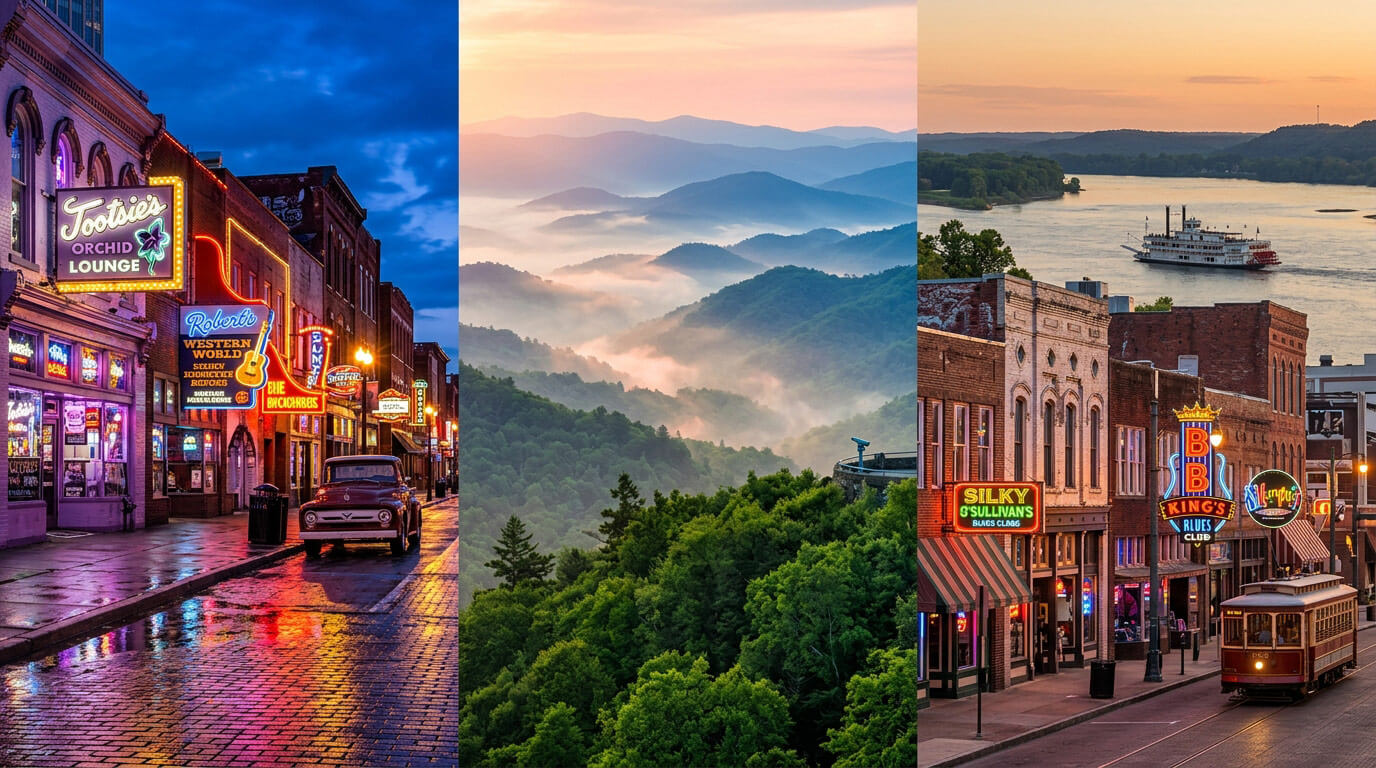
Tennessee runs the length of American roots music, from the honky-tonks of Nashville's Broadway to the birthplace of the blues on Memphis's Beale Street and Elvis Presley's Graceland estate. In between, the Great Smoky Mountains anchor the most-visited national park in the country, with Gatlinburg, Pigeon Forge, and Dollywood pulling in millions of visitors a year on the Tennessee side alone. Chattanooga, reinvented from an industrial river town into an outdoor recreation hub, and Knoxville, the gateway to the Smokies from the north, round out a state defined almost as much by its music history as its mountains.
Top Attractions, Tours and Tickets in Tennessee
Nashville: Music City & Broadway
Nashville earned its Music City nickname honestly, with live bands playing for tips in nearly every honky-tonk along Broadway from mid-afternoon until well past midnight. The Grand Ole Opry, broadcasting live country music radio since 1925, remains the genre's most storied stage, having launched or featured nearly every major country artist of the past century, and a backstage tour walks through the dressing rooms and history behind the show. The historic Ryman Auditorium, the Opry's original home before it moved to a larger venue, still hosts concerts today and is worth a stop even without a show playing.
Book Grand Ole Opry Backstage TourCountry Music Hall of Fame & Music Row
The Country Music Hall of Fame and Museum traces the genre from its Appalachian folk and blues roots through its modern crossover into mainstream pop, with instruments, stage costumes, and handwritten lyrics from across the genre's history on display. Nearby Music Row, a stretch of unassuming houses converted into recording studios and record label offices, remains the industry's working center, where much of Nashville's music is still actually recorded rather than just performed. RCA Studio B, where Elvis Presley recorded more than 200 songs, sits at the edge of the district and can be toured separately.
Book Country Music Hall of Fame & MuseumMemphis: Beale Street & Graceland
Memphis shaped as much of American music as Nashville, just in a different direction, with Beale Street's blues clubs, Sun Studio's early rock and roll recordings, and Stax Records' soul and R&B catalog all originating within a few miles of each other. Graceland, Elvis Presley's Memphis estate, remains one of the most-visited private homes in the country, preserved largely as it looked when Presley lived there, down to the famous Jungle Room. The National Civil Rights Museum, built around the former Lorraine Motel where Martin Luther King Jr. was assassinated in 1968, adds an essential and sobering counterpoint to the city's music-focused reputation.
Book Memphis City Tour & Graceland EntryGatlinburg, Pigeon Forge & Dollywood
Pigeon Forge and Gatlinburg form the main gateway into Great Smoky Mountains National Park from the Tennessee side, and the strip connecting them is packed with dinner shows, outlet malls, and mini-golf courses built up around the area's tourism boom. Dollywood, Dolly Parton's namesake theme park in Pigeon Forge, combines wooden and steel roller coasters with an Appalachian craft and music theme that sets it apart from a typical amusement park, and its attached Splash Country water park adds a second full day of activities. The Gatlinburg SkyLift and SkyBridge, the longest pedestrian suspension bridge in North America, offer a quieter mountain view above the strip's crowds.
Book Dollywood Theme Park Entry TicketGreat Smoky Mountains National Park
Great Smoky Mountains National Park is the most-visited national park in the country, drawing more than twice the annual visitors of Grand Canyon, in part because it charges no entrance fee and sits within a day's drive of a huge share of the U.S. population. Cades Cove, an 11-mile loop road through a historic Appalachian settlement, is the park's single most popular stop, especially at dawn and dusk when white-tailed deer and black bears are most active. Clingmans Dome, the park's highest point at 6,643 feet, offers views into both Tennessee and North Carolina from an observation tower at the end of a steep half-mile paved trail.
Chattanooga & Lookout Mountain
Chattanooga has transformed since the 1960s, when it was cited as having the dirtiest air in the country, into a hub for outdoor recreation and remote tech workers drawn by the city's early investment in municipal gigabit internet. Lookout Mountain, rising directly over downtown, holds Ruby Falls, the tallest underground waterfall open to the public in the country, along with Rock City's garden trail and the Incline Railway, one of the steepest passenger railways in the world. The Tennessee Aquarium, on the riverfront downtown, was the first major freshwater-focused aquarium built in the United States.
Tennessee Whiskey Country & Civil War History
Lynchburg, a small Middle Tennessee town of fewer than 2,000 people, is home to the Jack Daniel's Distillery, the oldest registered distillery in the United States, still filtering its whiskey through sugar maple charcoal using the same process developed in the 1860s. Franklin, just south of Nashville, preserves one of the best-documented Civil War battlefields in the country, the site of the 1864 Battle of Franklin, one of the bloodiest single days of the war. Shiloh National Military Park, in the state's southwest corner near the Mississippi border, marks an even earlier and bloodier 1862 battle that first showed both sides how costly the war would become.
Major Cities and Places to Visit in Tennessee
- Nashville Tours & Tickets - Tennessee's state capital and Music City, built around the Grand Ole Opry, honky-tonk-lined Broadway, and one of the fastest-growing downtown skylines in the South.
- Memphis Tours & Tickets - A Mississippi River city where American music history runs deep, from Sun Studio and Stax Records to Elvis Presley's Graceland estate.
- Chattanooga Tours & Tickets - A Tennessee River city at the base of Lookout Mountain, reinvented from a heavily polluted industrial town into an outdoor recreation and tech hub.
- Knoxville Tours & Tickets - An East Tennessee city on the Tennessee River, home to the University of Tennessee and the gateway to the Great Smoky Mountains from the north.
- Gatlinburg Tours & Tickets - A mountain resort town at the entrance to Great Smoky Mountains National Park, known for its arts and crafts community and the Gatlinburg SkyLift.
- Pigeon Forge Tours & Tickets - A Smoky Mountains tourism town built around Dollywood, Dolly Parton's namesake theme park, and a strip of dinner shows and outlet malls.
- Franklin Tours & Tickets - A Nashville suburb with one of the best-preserved Civil War battlefields in the country and a walkable, boutique-filled historic downtown.
- Lynchburg Tours & Tickets - A small Middle Tennessee town, home to the Jack Daniel's Distillery, the oldest registered distillery in the United States.
Universities, Colleges and Sports Teams in Tennessee
- Vanderbilt University in Nashville - A private research university in Nashville, consistently ranked among the top universities in the country.
- University of Tennessee in Knoxville - The state's flagship public research university in Knoxville, home of the Tennessee Volunteers.
- Tennessee Titans (sports team) in Nashville - NFL franchise playing home games at Nissan Stadium on the east bank of the Cumberland River in Nashville.
- Nashville Predators (sports team) in Nashville - NHL franchise playing home games at Bridgestone Arena in downtown Nashville.
- Memphis Grizzlies (sports team) in Memphis - NBA franchise playing home games at FedExForum in downtown Memphis.
Tennessee Demographics and Population
According to the 2024 American Community Survey, Tennessee has a population of approximately 7,378,861 people across 41,224 square miles, ranking it 15th among U.S. states by population. The median household income is $71,997, and the largest racial and ethnic groups are Asian (1.9%), White (73.5%), Hispanic Latino (7.4%), American Indian and Alaska Native (0.6%), and Black or African American (15.9%). The median age is 39.1 years, and the per capita income is $40,729. Approximately 13.5% of residents live below the poverty line, compared to the national rate of 12.5%. Tennessee has 2,928,765 households and a mean commute time of 26.5 minutes. Tennessee has no state income tax on wages, and its economy blends Nashville's healthcare and music industries, Memphis's status as a global logistics hub anchored by FedEx's headquarters, and automotive manufacturing plants across the state built by Nissan and Volkswagen.
When to Visit Tennessee
Winter (December through February): Mild in Nashville and Memphis, but colder with occasional snow in the Great Smoky Mountains, where some higher-elevation roads close seasonally. Spring (March through May): Warm and blooming, with wildflowers across the Smokies and comfortable hiking weather before summer humidity sets in. Summer (June through August): Hot and humid statewide, and the peak season for Dollywood and the Smoky Mountains despite the crowds and heat. Fall (September through November) is the best time to visit Tennessee. Warm early on, cooling into the state's best hiking weather, with vivid foliage across the Great Smoky Mountains typically peaking in mid-to-late October.
Frequently Asked Questions About Touring Tennessee
Official Tennessee Resources
The following official government websites provide additional planning resources, park information, and historical records for travelers visiting Tennessee.
| Resource | Description | Website |
|---|---|---|
| Tennessee Vacation | The state's official travel and tourism site with attraction guides, events, and trip planning tools. | www.tnvacation.com/ |
| Tennessee State Parks | Official listing of Tennessee's state parks and natural areas, run by the Department of Environment and Conservation. | tnstateparks.com/ |
| Tennessee State Library and Archives | State agency responsible for preserving historical government records and documents for research and genealogy. | sos.tn.gov/tsla |
| TN.gov | The official portal for Tennessee state government services and information. | www.tn.gov/ |