Last updated August 18, 2026
The Best Tours & Places to Visit in Virginia
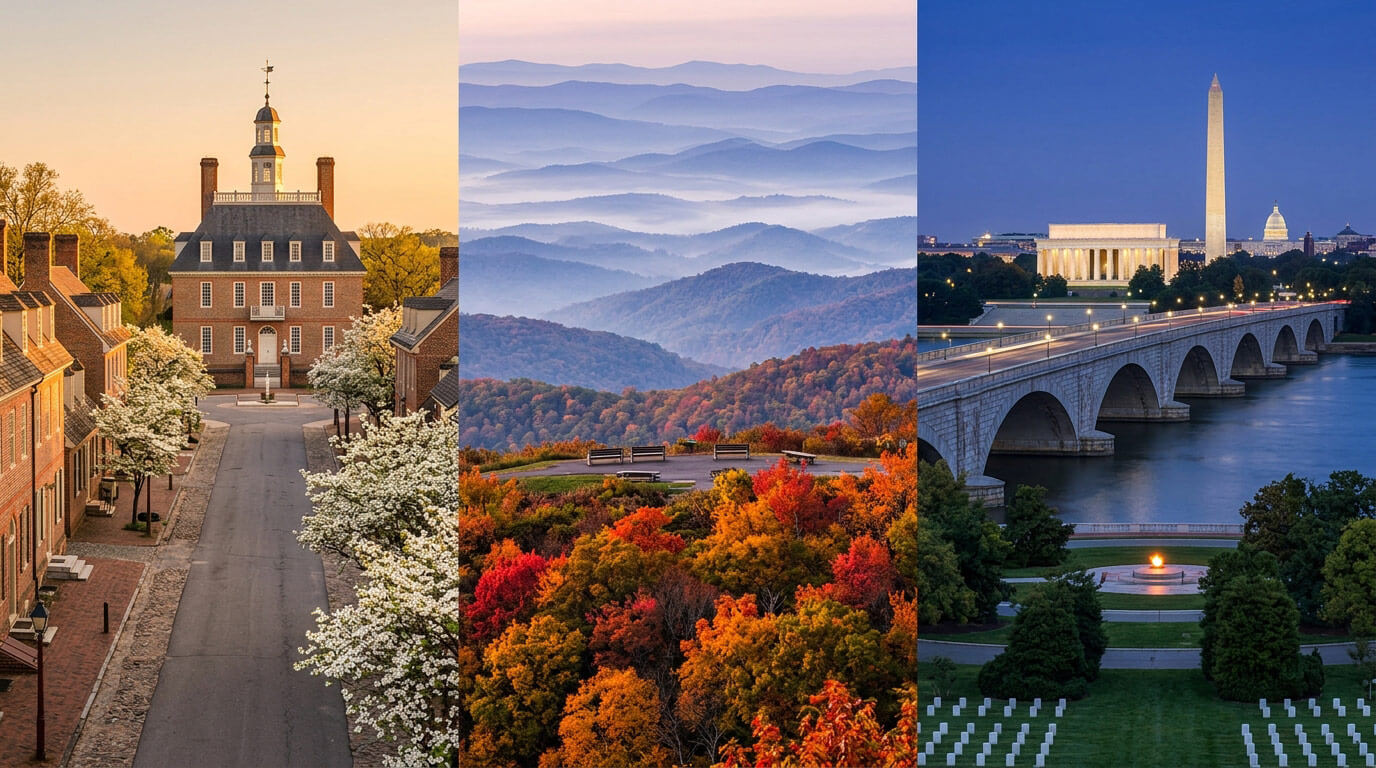
Virginia carries more early American history per square mile than almost any other state, from the restored colonial capital at Williamsburg to George Washington's Mount Vernon and Thomas Jefferson's Monticello. The Blue Ridge Mountains and Shenandoah National Park give the state a genuinely different side once you leave the Tidewater region, and Virginia Beach anchors a full Atlantic coastline that rarely gets mentioned in the same breath as the state's historical sites. Richmond, the state capital and former capital of the Confederacy, and the Washington, D.C. suburbs of Arlington and Alexandria round out a state whose identity spans nearly the entire arc of American history.
Top Attractions, Tours and Tickets in Virginia
Colonial Williamsburg
Williamsburg served as the capital of colonial Virginia from 1699 to 1780, and its Historic Area has been restored and reconstructed into the largest living-history museum in the country, with costumed interpreters staffing the Capitol, the Governor's Palace, and dozens of working 18th-century trade shops. Williamsburg anchors Virginia's "Historic Triangle" alongside Jamestown, the site of the first permanent English settlement in North America in 1607, and Yorktown, where the decisive final battle of the Revolutionary War was fought in 1781. A single admission ticket covers the full Historic Area, including guided tours of the Capitol and Governor's Palace.
Book Colonial Williamsburg TicketMount Vernon
George Washington's Mount Vernon estate, overlooking the Potomac River south of Alexandria, remains one of the most-visited historic homes in the country, preserved with much of its original furniture and a working reconstructed farm on the grounds. The mansion itself, expanded by Washington over several decades, sits above a bluff with sweeping river views largely unchanged since the 18th century, and Washington's tomb, along with a museum covering his military and presidential career, rounds out the visit. Mount Vernon's location less than 20 miles from downtown Washington, D.C. makes it one of the easiest historic day trips from the capital.
Book Mount Vernon Estate Ticket with Audio GuideMonticello & Charlottesville
Charlottesville is built almost entirely in the shadow of Thomas Jefferson, who designed both the University of Virginia's original campus, a UNESCO World Heritage Site, and Monticello, his neoclassical mountaintop home just outside the city. Monticello's design reflects Jefferson's decades of architectural experimentation and his fascination with invention, evident in details like a seven-day calendar clock and dumbwaiters built directly into the dining room fireplace. Tours of the house are balanced by increasingly direct exhibits on Mulberry Row, where Monticello's enslaved workforce lived, giving visitors a fuller picture of the estate than a purely architectural tour would.
Book Monticello Small Group Day Tour from DCShenandoah National Park
Shenandoah National Park stretches along more than 100 miles of the Blue Ridge Mountains, with Skyline Drive running the entire length of the park and offering more than 70 overlooks without requiring a single step out of the car. Old Rag Mountain, one of the park's most popular hikes, adds a strenuous rock scramble near the summit that draws experienced hikers from across the mid-Atlantic, while gentler trails lead to waterfalls like Dark Hollow Falls, the closest cascade to Skyline Drive. Luray Caverns, just outside the park's boundary, adds an underground counterpoint with the world's largest musical instrument, a "Stalacpipe Organ" that plays the cave's natural formations.
Book Shenandoah National Park & Luray Caverns TourVirginia Beach
Virginia Beach, Virginia's largest city by population, centers on a three-mile boardwalk lined with hotels, restaurants, and a dedicated bike path, backed by the Guinness World Record-holding title of the longest pleasure beach in the world. The Virginia Aquarium & Marine Science Center covers the region's coastal ecosystems in detail, and the calmer waters of the Chesapeake Bay side of the city, away from the Atlantic-facing boardwalk, are the more common spot for dolphin sightings. First Landing State Park, at the northern end of the city, marks the approximate site where English colonists first came ashore in Virginia in 1607, before continuing on to found Jamestown.
Book Virginia Beach Dolphin Kayaking TourRichmond & Civil War History
Richmond served as the capital of the Confederacy for nearly the entire Civil War, and sites across the city, including the Confederate White House and the American Civil War Museum, cover that history alongside Richmond's earlier role in the Revolutionary era, when Patrick Henry delivered his "give me liberty" speech at St. John's Church. Beyond its Civil War history, Richmond has reinvented its riverfront and Fan District neighborhoods with breweries, murals, and a growing restaurant scene built around the James River, which runs directly through downtown and offers whitewater rafting rare for a state capital.
The Blue Ridge Parkway & Southwest Virginia
The Blue Ridge Parkway begins at Shenandoah National Park's southern end near Roanoke and runs 469 miles into North Carolina, carrying the nickname "America's Favorite Drive" for its unbroken run of mountain overlooks with no commercial traffic allowed. Roanoke itself, the largest city in southwest Virginia, sits directly along the parkway and is marked by the 100-foot illuminated Roanoke Star on Mill Mountain, visible from much of the city at night. Farther southwest, Natural Bridge, a 215-foot limestone arch once surveyed by a young George Washington, remains one of Virginia's oldest tourist attractions, drawing visitors since the 18th century.
Major Cities and Places to Visit in Virginia
- Richmond Tours & Tickets - Virginia's state capital on the James River, once the capital of the Confederacy and now home to a growing arts, brewery, and mural scene.
- Virginia Beach Tours & Tickets - Virginia's largest city and the state's main Atlantic beach resort, with a three-mile boardwalk and the country's longest pleasure beach.
- Norfolk Tours & Tickets - A Hampton Roads port city and home to the world's largest naval base, along with the Chrysler Museum of Art.
- Williamsburg Tours & Tickets - The restored 18th-century capital of colonial Virginia, anchored by Colonial Williamsburg's living-history historic area.
- Charlottesville Tours & Tickets - A central Virginia college town at the base of the Blue Ridge Mountains, home to the University of Virginia and Thomas Jefferson's Monticello.
- Arlington Tours & Tickets - A Washington, D.C. suburb across the Potomac River, home to Arlington National Cemetery and the Pentagon.
- Alexandria Tours & Tickets - A historic Potomac River port city with a cobblestone Old Town, founded in 1749.
- Roanoke Tours & Tickets - The largest city in southwest Virginia, set in a valley of the Blue Ridge Mountains and known for the illuminated Roanoke Star overlooking downtown.
Universities, Colleges and Sports Teams in Virginia
- University of Virginia in Charlottesville - A public research university founded by Thomas Jefferson in 1819, with an original campus designated a UNESCO World Heritage Site.
- Virginia Tech - A public land-grant research university based in Blacksburg, home of the Virginia Tech Hokies.
- William & Mary in Williamsburg - A public research university chartered in 1693, the second-oldest institution of higher education in the country after Harvard.
Virginia Demographics and Population
According to the 2024 American Community Survey, Virginia has a population of approximately 8,811,195 people across 39,481 square miles, ranking it 12th among U.S. states by population. The median household income is $92,090, and the largest racial and ethnic groups are Asian (6.8%), White (61.7%), Hispanic Latino (10.6%), American Indian and Alaska Native (0.3%), and Black or African American (18.7%). The median age is 39.4 years, and the per capita income is $50,866. Approximately 9.7% of residents live below the poverty line, compared to the national rate of 12.5%. Virginia has 3,449,307 households and a mean commute time of 28.3 minutes. Virginia's economy is heavily shaped by federal government and defense spending, including the world's largest naval base at Norfolk and the Pentagon in Arlington, alongside a fast-growing technology and data center corridor in Northern Virginia.
When to Visit Virginia
Winter (December through February): Mild along the coast and in Tidewater, colder and snowier in Shenandoah National Park and the Blue Ridge Mountains. Spring (March through May): Warm and blooming, with wildflowers along Skyline Drive and comfortable hiking weather before summer humidity sets in. Summer (June through August): Hot and humid statewide, the peak season for Virginia Beach despite the heat, with the mountains offering some relief. Fall (September through November) is the best time to visit Virginia. Cool and colorful, with strong foliage along the Blue Ridge Parkway and Skyline Drive typically peaking in mid-October.
Frequently Asked Questions About Touring Virginia
Official Virginia Resources
The following official government websites provide additional planning resources, park information, and historical records for travelers visiting Virginia.
| Resource | Description | Website |
|---|---|---|
| Virginia is for Lovers | The state's official travel and tourism site with attraction guides, events, and trip planning tools. | www.virginia.org/ |
| Virginia State Parks | Official listing of Virginia's state parks, run by the Department of Conservation and Recreation. | www.dcr.virginia.gov/state-parks/ |
| Library of Virginia | State agency responsible for preserving historical government records and documents for research and genealogy. | www.lva.virginia.gov/ |
| Virginia.gov | The official portal for Virginia state government services and information. | www.virginia.gov/ |