Last updated August 18, 2026
The Best Tours & Places to Visit in Washington, D.C.
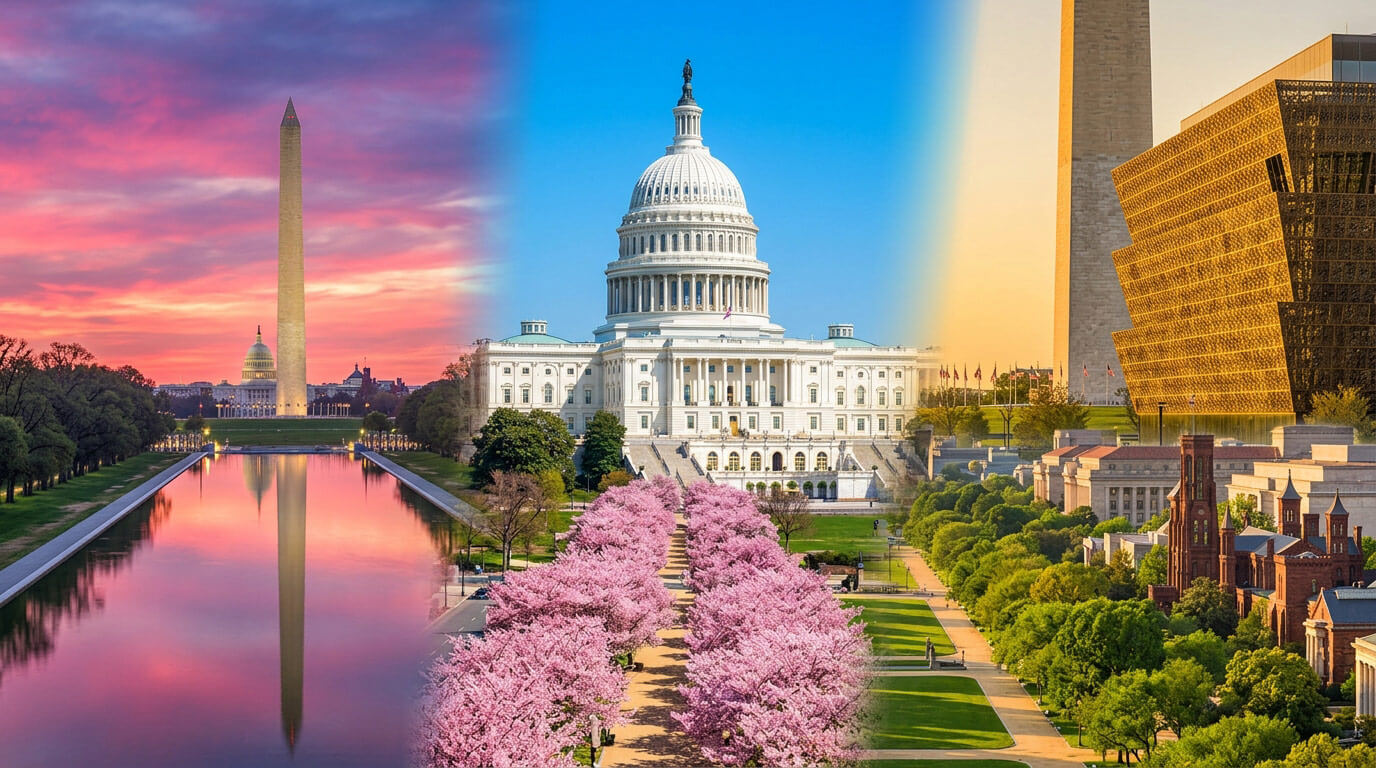
Washington, D.C. concentrates more free world-class museums and iconic monuments into a walkable footprint than almost anywhere else in the country, from the Smithsonian's 21 museums, every one of them free to enter, to the National Mall's stretch of memorials honoring everyone from Lincoln to the veterans of three wars. As the seat of the federal government, the city runs on politics in a way no state capital does, with the White House, U.S. Capitol, and Supreme Court all within a short walk of each other. Just across the Potomac, Arlington National Cemetery and Georgetown's cobblestone streets round out a visit, and the city's excellent Metro system means a car is one of the few things you genuinely don't need here.
Top Attractions, Tours and Tickets in Washington, D.C.
The National Mall & Monuments
The National Mall runs nearly two miles between the U.S. Capitol and the Lincoln Memorial, lined with memorials to Washington, Jefferson, and the veterans of World War II, Korea, and Vietnam. The Lincoln Memorial's steps, where Martin Luther King Jr. delivered his "I Have a Dream" speech in 1963, remain one of the most historically significant spots in the country, and the Reflecting Pool stretching out in front of it offers the classic postcard view back toward the Washington Monument. Most of the Mall's major monuments are free, unguarded, and open 24 hours, making an evening visit, when the crowds thin and the buildings are lit, one of the best times to see them.
Book National Mall Monuments & Memorials Sunset TourThe Smithsonian Museums
The Smithsonian Institution operates 21 museums and the National Zoo in Washington, all free to enter, making it one of the largest museum and research complexes in the world. The National Air and Space Museum, one of the most-visited museums on Earth, holds the Wright Flyer and Apollo 11's command module, while the National Museum of Natural History's Hope Diamond and dinosaur fossils draw crowds of their own. Because the museums are free but individual galleries can still require timed passes, especially at Air and Space, a guided tour that handles logistics and hits the highlights of several museums in one outing is worth it for a first visit.
Book Smithsonian Highlights Tour with Air & SpaceThe White House & Capitol Hill
The White House, the official residence of every U.S. president since John Adams in 1800, can be viewed from Lafayette Park to the north and the Ellipse to the south, though interior tours require advance requests through a member of Congress. A short walk east, the U.S. Capitol has hosted every presidential inauguration since Andrew Jackson's in 1829, and its Rotunda and Statuary Hall are open to the public through free, timed-entry tours. The Library of Congress, the largest library in the world, and the Supreme Court, both within a block of the Capitol, round out a walk through the physical seat of all three branches of the federal government.
Book White House, National Mall & Lincoln Memorial TourArlington National Cemetery
Arlington National Cemetery, just across the Potomac River in Virginia, holds the graves of more than 400,000 veterans and military family members across 639 rolling acres, including President John F. Kennedy's gravesite, marked by an eternal flame. The Tomb of the Unknown Soldier, guarded around the clock since 1937 regardless of weather, hosts a formal Changing of the Guard ceremony every hour in summer and every two hours in winter, drawing quiet, respectful crowds throughout the day. Arlington House, the pre-Civil War home of Robert E. Lee that once overlooked his own family's land before it was seized and turned into the cemetery, sits at the top of the hill with sweeping views back across the river to the National Mall.
Book Arlington National Cemetery Tour with Changing of the GuardGeorgetown
Georgetown predates the city of Washington itself, founded as a Maryland tobacco port in 1751 nearly four decades before the federal district existed, and its Federal-era rowhouses along cobblestone streets still reflect that earlier history. M Street and Wisconsin Avenue anchor the neighborhood's shopping and restaurant scene, while the Chesapeake and Ohio Canal, once used to haul coal and goods from western Maryland, now runs as a quiet towpath through the middle of the neighborhood. Georgetown University, founded in 1789 as the country's oldest Catholic and Jesuit university, occupies the neighborhood's western edge above the Potomac.
Book Georgetown Architecture Walking TourCherry Blossoms & the Tidal Basin
Washington's Yoshino cherry trees, a gift of 3,000 trees from the city of Tokyo in 1912, ring the Tidal Basin and typically reach peak bloom for about a week between late March and early April, drawing more than a million visitors during the annual National Cherry Blossom Festival. The Jefferson Memorial and Franklin Delano Roosevelt Memorial both sit directly on the Tidal Basin, giving the blossoms a monumental backdrop found nowhere else the trees grow. Paddle boats are available to rent right on the Tidal Basin during the season, offering a water-level view of the blossoms that the paved paths around the rim cannot match.
DC Neighborhoods & Local Culture
Beyond the monuments, Washington's neighborhoods carry their own distinct histories. U Street, once nicknamed "Black Broadway" for a jazz-era scene that rivaled Harlem's, is still anchored by Ben's Chili Bowl, in continuous operation since 1958 and a regular stop for U.S. presidents. Navy Yard, once a working shipyard, has been rebuilt around Nationals Park and a riverfront path of breweries and restaurants, while Anacostia, east of the river, preserves Cedar Hill, the hilltop home of abolitionist Frederick Douglass, with sweeping views back across the city.
Major Cities and Places to Visit in Washington, D.C.
- Georgetown Tours & Tickets - A historic riverside neighborhood predating the city of Washington itself, known for its Federal-era rowhouses, M Street shopping, and the Georgetown University campus.
- Capitol Hill Tours & Tickets - The neighborhood surrounding the U.S. Capitol, home to the Library of Congress, Eastern Market, and one of the largest historic residential districts in the city.
- Dupont Circle Tours & Tickets - A walkable, embassy-lined neighborhood built around a traffic circle and park, known for its architecture and a dense concentration of restaurants and bookstores.
- Adams Morgan Tours & Tickets - A diverse, nightlife-heavy neighborhood known for its international restaurant scene and 18th Street corridor.
- U Street Tours & Tickets - A historic African American cultural corridor once nicknamed "Black Broadway," home to the Lincoln Theatre and Ben's Chili Bowl.
- Foggy Bottom Tours & Tickets - A neighborhood west of the White House, home to George Washington University and the Kennedy Center for the Performing Arts.
- Navy Yard Tours & Tickets - A revitalized waterfront neighborhood along the Anacostia River, home to Nationals Park and a growing riverwalk of restaurants and breweries.
- Anacostia Tours & Tickets - A historically significant neighborhood east of the Anacostia River, home to Frederick Douglass's hilltop estate, Cedar Hill.
Universities, Colleges and Sports Teams in Washington, D.C.
- Georgetown University in Georgetown - The country's oldest Catholic and Jesuit university, founded in 1789, with a campus overlooking the Potomac River.
- George Washington University in Foggy Bottom - A private research university in Foggy Bottom, one of the largest universities in the district by enrollment.
- Howard University - A private research university and one of the country's most prominent historically Black universities, founded in 1867.
- Washington Nationals (sports team) in Navy Yard - MLB franchise playing home games at Nationals Park in the Navy Yard neighborhood, 2019 World Series champions.
- Washington Wizards (sports team) - NBA franchise playing home games at Capital One Arena in downtown Washington.
- Washington Capitals (sports team) - NHL franchise also based at Capital One Arena, 2018 Stanley Cup champions.
Washington, D.C. Demographics and Population
According to the 2024 American Community Survey, Washington, D.C. has a population of approximately 702,250 people across 61 square miles. The median household income is $109,700, and the largest racial and ethnic groups are Asian (4%), White (39.6%), Hispanic Latino (11.1%), American Indian and Alaska Native (0.3%), and Black or African American (44.3%). The median age is 34.9 years, and the per capita income is $76,604. Approximately 17.3% of residents live below the poverty line, compared to the national rate of 12.2%. Washington, D.C. has 324,491 households and a mean commute time of 30.0 minutes. Washington, D.C.'s economy is dominated by the federal government and the vast network of law firms, lobbying groups, trade associations, and government contractors built around it, alongside a large higher education and healthcare sector and a tourism industry drawing tens of millions of visitors a year to its free national museums and monuments.
When to Visit Washington, D.C.
Winter (December through February): Cold with occasional snow, but the Smithsonian museums and other indoor attractions make it one of the least crowded and most comfortable times to visit. Spring (March through May) is the best time to visit Washington, D.C.. Mild and the city's signature season, with cherry blossoms around the Tidal Basin typically peaking in late March or early April during the National Cherry Blossom Festival. Summer (June through August): Hot and humid, the busiest season on the National Mall, with Fourth of July fireworks over the Washington Monument drawing especially large crowds. Fall (September through November): Mild and increasingly comfortable, with foliage around the Tidal Basin and National Mall and noticeably thinner crowds than spring or summer.
Frequently Asked Questions About Touring Washington, D.C.
Official Washington, D.C. Resources
The following official government websites provide additional planning resources, park information, and historical records for travelers visiting Washington, D.C..
| Resource | Description | Website |
|---|---|---|
| Destination DC | The city's official travel and tourism site with attraction guides, events, and trip planning tools. | washington.org/ |
| National Mall & Memorial Parks (NPS) | The National Park Service's official site for the National Mall, monuments, and memorials. | www.nps.gov/nama/ |
| DC Office of Public Records and Archives | The district's archives, responsible for preserving historical government records for research and genealogy. | archives.dc.gov/ |
| DC.gov | The official portal for District of Columbia government services and information. | dc.gov/ |