Last updated August 18, 2026
The Best Tours & Places to Visit in Washington
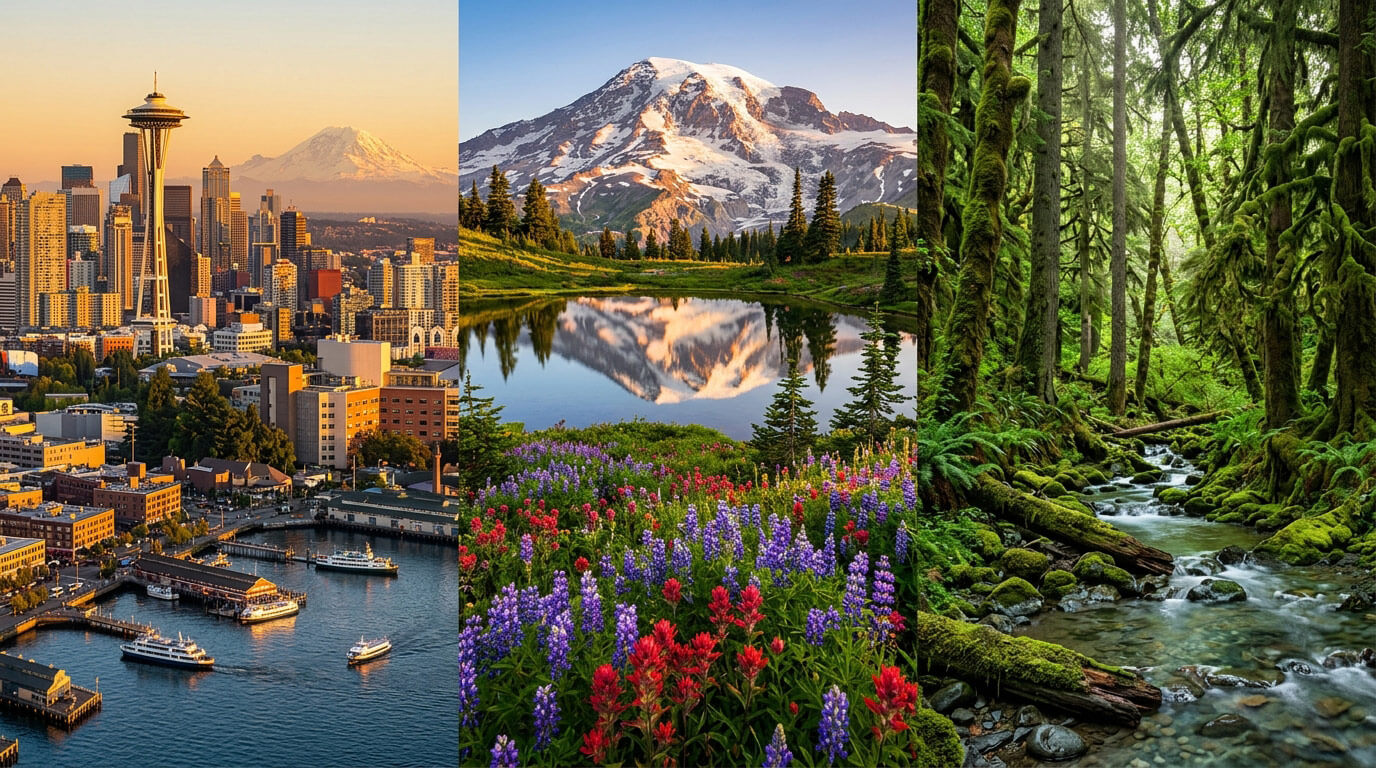
Washington pairs Seattle's Space Needle and coffee culture with some of the most varied landscapes of any state, from Mount Rainier's glaciers to the temperate rainforest of Olympic National Park and the whale-filled waters around the San Juan Islands. Puget Sound cuts through the western half of the state, giving Seattle, Tacoma, and dozens of ferry-connected islands direct access to the water, while the Cascade Mountains split the state in two, dividing the rainy, green west from the dry, sun-heavy vineyards of eastern Washington around Walla Walla. Contrary to its rainy reputation, Washington actually sees dry, sunny summers, which is when most of the state's outdoor attractions are at their best.
Top Attractions, Tours and Tickets in Washington
Seattle: Pike Place Market & the Space Needle
Seattle's Pike Place Market, open continuously since 1907, remains one of the oldest continuously operated public farmers markets in the country, famous for its fish-throwing vendors and as the site of the original Starbucks storefront. The Space Needle, built for the 1962 World's Fair, still anchors the skyline from Seattle Center, alongside the Chihuly Garden and Glass museum showcasing hometown glass artist Dale Chihuly's work. Gas Works Park, a former gasification plant turned public park on Lake Union, offers one of the best skyline views in the city and a good sense of Seattle's industrial past.
Book Seattle City Tour with Pike Place MarketMount Rainier National Park
Mount Rainier, a 14,411-foot active volcano visible from much of the Puget Sound region on a clear day, is the most heavily glaciated peak in the contiguous United States, with 26 named glaciers covering its slopes. The Paradise area, on the mountain's south side, offers the park's most accessible wildflower meadows and trails, along with the historic Paradise Inn, while Sunrise, on the drier east side, reaches the highest point accessible by vehicle in the park. Reflection Lake, when calm, mirrors the mountain almost perfectly, making it one of the most photographed spots in the entire national park system.
Book Mount Rainier National Park Guided TourOlympic National Park
Olympic National Park packs three distinct ecosystems into one park: glacier-capped mountains, old-growth temperate rainforest at the Hoh Rain Forest, one of the wettest places in the contiguous United States, and more than 70 miles of wild Pacific coastline. Hurricane Ridge offers sweeping mountain views reachable by a paved road just a 45-minute drive from Port Angeles, while Lake Crescent, a glacially carved lake with strikingly clear water, sits along the park's main highway corridor. The park's isolation from the rest of Washington by the Olympic Mountains has kept much of its forest genuinely old-growth and undisturbed.
Book Olympic National Park Day TourSan Juan Islands & Orca Whale Watching
The San Juan Islands, an archipelago of more than 170 islands in the waters between Washington and Vancouver Island, are one of the most reliable places in the country to see orca whales in the wild, with resident and transient pods passing through the surrounding Salish Sea regularly from spring through fall. Friday Harbor, on San Juan Island, and Anacortes, on the mainland, both serve as departure points for whale-watching boats, and San Juan Island's Lime Kiln Point State Park is one of the few places in the world where orcas can sometimes be spotted directly from shore. Orcas Island and Lopez Island round out the archipelago with quieter, less-developed alternatives to San Juan Island itself.
Book Anacortes Orca Whale Watching TourWoodinville & Washington Wine Country
Washington is the second-largest wine-producing state in the country after California, and Woodinville, just 30 minutes northeast of Seattle, concentrates more than 130 tasting rooms into a single town despite having almost no vineyards of its own, since most of the state's grapes are grown across the Cascades in the dry Columbia Valley. Farther east, Walla Walla anchors the state's more traditional wine country, with over 120 wineries spread across a landscape closer in climate to eastern Oregon than the wet Puget Sound region. A guided wine tour from Seattle is an easy way to visit several Woodinville wineries in an afternoon without needing a designated driver.
Book Woodinville Guided Wine TourThe North Cascades
North Cascades National Park, in Washington's far north near the Canadian border, holds more glaciers than any other place in the contiguous United States outside Alaska, along with jagged peaks that have earned the range the nickname the "American Alps." The North Cascades Highway, open only seasonally due to heavy winter snowfall, threads through the park past turquoise Diablo Lake, colored by fine glacial rock flour suspended in the water. Because the park requires more effort to reach than Mount Rainier or Olympic, it remains one of the least-visited national parks in the country despite scenery that rivals both.
Eastern Washington
Eastern Washington, on the dry side of the Cascade Mountains, looks almost nothing like the rainy, forested image most people have of the state, trading evergreens for wheat fields, sagebrush, and the vineyards of the Columbia Valley. Spokane, the region's largest city, sits along the Spokane River and still carries traces of the 1974 World's Fair at Riverfront Park, home to a giant red wagon sculpture that has become a local landmark. Dry Falls, near Coulee City, marks what was once the largest waterfall known to have existed on Earth, carved by catastrophic Ice Age floods that shaped much of the region's unusual scarred landscape, known as the Channeled Scablands.
Major Cities and Places to Visit in Washington
- Seattle Tours & Tickets - Washington's largest city, built around Puget Sound and the Space Needle, and headquarters to Amazon, Starbucks, and Boeing's commercial airplane division.
- Spokane Tours & Tickets - Washington's second-largest city, in the state's Inland Northwest region, built around the Spokane River and Riverfront Park, site of the 1974 World's Fair.
- Tacoma Tours & Tickets - A Puget Sound port city south of Seattle, known for the Museum of Glass and the work of hometown glass artist Dale Chihuly.
- Olympia Tours & Tickets - Washington's state capital at the southern tip of Puget Sound, home to a domed 1928 State Capitol modeled on the U.S. Capitol.
- Bellevue Tours & Tickets - A fast-growing tech hub across Lake Washington from Seattle, close to Microsoft's headquarters in nearby Redmond.
- Vancouver Tours & Tickets - A Columbia River city across from Portland, Oregon, with its own distinct downtown and Fort Vancouver National Historic Site.
- Walla Walla Tours & Tickets - A southeastern Washington wine town with more than 120 wineries, alongside Whitman College and a walkable historic downtown.
- Port Angeles Tours & Tickets - The main gateway to Olympic National Park, on the Strait of Juan de Fuca with ferry service to Victoria, British Columbia.
Universities, Colleges and Sports Teams in Washington
- University of Washington in Seattle - The state's flagship public research university in Seattle, home of the Washington Huskies.
- Washington State University - A public land-grant research university based in Pullman, home of the Washington State Cougars.
- Seattle Seahawks (sports team) in Seattle - NFL franchise playing home games at Lumen Field in downtown Seattle, known for one of the loudest fan bases in the league.
- Seattle Mariners (sports team) in Seattle - MLB franchise playing home games at T-Mobile Park in downtown Seattle.
- Seattle Kraken (sports team) in Seattle - NHL franchise playing home games at Climate Pledge Arena on the Seattle Center campus.
Washington Demographics and Population
According to the 2024 American Community Survey, Washington has a population of approximately 7,958,180 people across 66,455 square miles, ranking it 13th among U.S. states by population. The median household income is $99,400, and the largest racial and ethnic groups are Asian (9.7%), White (63.1%), Hispanic Latino (14.4%), American Indian and Alaska Native (2.1%), and Black or African American (3.8%). The median age is 38.7 years, and the per capita income is $55,177. Approximately 9.9% of residents live below the poverty line, compared to the national rate of 12.5%. Washington has 3,168,080 households and a mean commute time of 26.6 minutes. Washington has no state income tax, and its economy is anchored by aerospace manufacturing at Boeing, technology giants Amazon and Microsoft headquartered in the Seattle area, and one of the country's most productive agricultural regions in the orchards and vineyards of eastern Washington.
When to Visit Washington
Winter (December through February): Mild and rainy in Seattle and Puget Sound, with heavy snowfall in the Cascades powering ski season at resorts like Crystal Mountain and Stevens Pass. Spring (March through May): Blooming and increasingly dry, with the Skagit Valley Tulip Festival in April drawing crowds to fields of tulips north of Seattle. Summer (June through August) is the best time to visit Washington. Dry, sunny, and widely considered the best season in the state, contrary to Washington's rainy reputation, and the peak season for the San Juan Islands, Mount Rainier, and Olympic National Park. Fall (September through November): Rain returning by October in western Washington, but a good season for the Walla Walla and Woodinville wine harvest and thinner crowds statewide.
Frequently Asked Questions About Touring Washington
Official Washington Resources
The following official government websites provide additional planning resources, park information, and historical records for travelers visiting Washington.
| Resource | Description | Website |
|---|---|---|
| Washington State Tourism | The state's official travel and tourism site with attraction guides, events, and trip planning tools. | stateofwatourism.com/ |
| Washington State Parks | Official listing of Washington's state parks, run by the State Parks and Recreation Commission. | parks.wa.gov/ |
| Washington State Archives | State agency responsible for preserving historical government records and documents for research and genealogy. | www.sos.wa.gov/archives |
| WA.gov | The official portal for Washington state government services and information. | wa.gov/ |