Last updated August 18, 2026
The Best Tours & Places to Visit in West Virginia
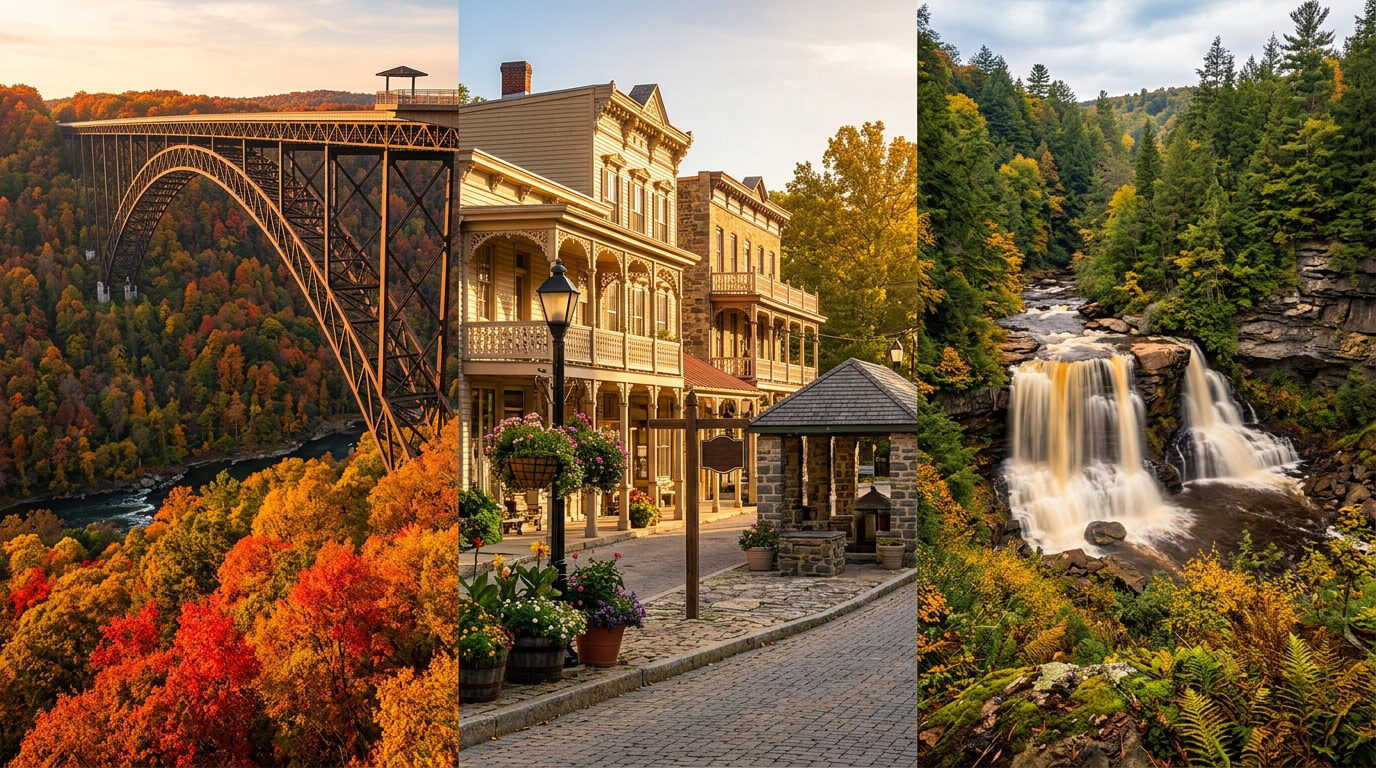
West Virginia is the only state entirely contained within the Appalachian Mountains, and its newest calling card, New River Gorge National Park, only became the country's 63rd national park in 2020 despite its 876-foot bridge and whitewater rapids having drawn rafters and climbers for decades. Harpers Ferry anchors the state's Civil War and abolitionist history in the Eastern Panhandle, while The Greenbrier resort in the south has hosted presidents and foreign dignitaries since the 18th century. Between the mountains, coal mining still shapes much of the state's identity and economy, even as tourism around its rivers and ridgelines has become an increasingly large part of West Virginia's story.
Top Attractions, Tours and Tickets in West Virginia
New River Gorge National Park
New River Gorge National Park, despite its name, carries one of the oldest rivers in North America, cutting through a 1,000-foot-deep gorge in south-central West Virginia over more than 300 million years. The New River Gorge Bridge, one of the longest steel single-span bridges in the world at 3,030 feet, frames nearly every photo of the park and hosts Bridge Day every October, when the road closes for one day so BASE jumpers can legally parachute off it. Below the bridge, the Lower New River offers some of the best whitewater rafting in the eastern United States, with rapids ranging up to Class V depending on water levels, alongside rock climbing considered among the best on the East Coast.
Book Lower New River Full-Day Rafting TourHarpers Ferry & the Eastern Panhandle
Harpers Ferry, at the confluence of the Potomac and Shenandoah Rivers where Virginia, Maryland, and West Virginia meet, is best known as the site of abolitionist John Brown's failed 1859 raid on the federal armory, an event widely seen as one of the sparks that led directly to the Civil War. The town's preserved 19th-century streets, now part of Harpers Ferry National Historical Park, sit below dramatic river-carved cliffs that Thomas Jefferson once called "one of the most stupendous scenes in nature." Nearby Antietam National Battlefield, just across the Maryland line, marks the site of the single bloodiest day in American military history and pairs naturally with a Harpers Ferry visit.
Book Harpers Ferry & Antietam Battlefield TourThe Greenbrier & Southern West Virginia
The Greenbrier, in White Sulphur Springs, has operated as a resort since 1778 and has hosted 27 U.S. presidents over its history, along with a still-functioning Cold War-era fallout shelter built secretly beneath the resort for Congress and declassified only in 1992. The resort's manicured grounds, golf courses, and grand white facade give southern West Virginia a level of old-money elegance that stands in sharp contrast to the coal towns surrounding it. Nearby, Lost World Caverns and Pipestem Resort State Park round out the region's draws for visitors who want to combine the Greenbrier's polish with more rugged Appalachian scenery.
Seneca Rocks & the Potomac Highlands
Seneca Rocks, a 900-foot Tuscarora sandstone formation rising sharply above the North Fork River, is one of the most recognizable rock formations east of the Mississippi and one of the premier traditional rock climbing destinations on the East Coast. The Potomac Highlands surrounding it hold some of the highest terrain in the state, including Spruce Knob, West Virginia's highest point at 4,863 feet, reachable by a paved road most of the way to the summit. Dolly Sods Wilderness, with its wind-sculpted trees and high-elevation bog terrain, feels closer to the tundra of eastern Canada than anywhere else in the mid-Atlantic.
Blackwater Falls & Canaan Valley
Davis sits at the center of West Virginia's highest-elevation region, anchored by Blackwater Falls State Park, where the Blackwater River drops 57 feet over sandstone ledges, stained amber by tannins from the surrounding red spruce and hemlock forest. Canaan Valley, one of the highest valleys east of the Mississippi at over 3,000 feet, holds a climate and ecosystem more typical of a much more northern latitude, complete with ski resorts that draw skiers from across the mid-Atlantic each winter. The combination of elevation and northern-leaning ecology has made this corner of the state a magnet for both winter sports and summer hiking.
Charleston & the Kanawha Valley
Charleston, West Virginia's state capital, sits on the Kanawha River beneath a gold-leafed State Capitol dome that stands slightly taller than the U.S. Capitol's. The surrounding Kanawha Valley grew into a center of chemical manufacturing in the 20th century, giving the region the nickname "Chemical Valley," a legacy still visible in the industrial plants along the river. The West Virginia State Museum, housed in the Culture Center on the Capitol grounds, covers the state's full history from its Appalachian geology through coal mining and its 1863 split from Virginia during the Civil War.
Coal Mining Heritage & Appalachian Culture
Coal defined West Virginia's economy and identity for more than a century, and sites like the Beckley Exhibition Coal Mine let visitors ride an actual mine car underground, guided by retired miners who explain the working conditions that shaped the region's labor history. The Battle of Blair Mountain, the largest labor uprising in U.S. history, was fought in 1921 in Logan County, when thousands of striking coal miners clashed with private security forces and eventually federal troops. Beyond mining itself, Appalachian musical traditions, including old-time and bluegrass music, remain deeply rooted in the state, celebrated each year at festivals like the Vandalia Gathering in Charleston.
Major Cities and Places to Visit in West Virginia
- Charleston Tours & Tickets - West Virginia's state capital on the Kanawha River, home to a gold-domed 1932 State Capitol and the Clay Center for the Arts and Sciences.
- Fayetteville Tours & Tickets - A small mountain town and the main gateway to New River Gorge National Park, built almost entirely around whitewater rafting and rock climbing.
- Harpers Ferry Tours & Tickets - A historic town at the confluence of the Potomac and Shenandoah Rivers, the site of John Brown's 1859 raid on a federal armory.
- Morgantown Tours & Tickets - A university town on the Monongahela River, home to West Virginia University and one of the busiest college towns in the state.
- Huntington Tours & Tickets - West Virginia's second-largest city, on the Ohio River near the Kentucky and Ohio borders, home to Marshall University.
- Berkeley Springs Tours & Tickets - The country's first spa town, where George Washington himself soaked in the area's warm mineral springs in the 18th century.
- White Sulphur Springs Tours & Tickets - A small Greenbrier County town built entirely around The Greenbrier, a historic luxury resort operating since 1778.
- Davis Tours & Tickets - A small mountain town at over 3,000 feet elevation, the gateway to Blackwater Falls State Park and Canaan Valley.
Universities, Colleges and Sports Teams in West Virginia
- West Virginia University in Morgantown - The state's flagship public research university in Morgantown, home of the WVU Mountaineers.
- Marshall University in Huntington - A public research university in Huntington, home of the Marshall Thundering Herd.
West Virginia Demographics and Population
According to the 2024 American Community Survey, West Virginia has a population of approximately 1,778,373 people across 24,078 square miles, ranking it 38th among U.S. states by population. The median household income is $60,798, and the largest racial and ethnic groups are Asian (0.8%), White (88.9%), Hispanic Latino (2.1%), American Indian and Alaska Native (0.4%), and Black or African American (3.1%). The median age is 43.0 years, and the per capita income is $32,949. Approximately 16.7% of residents live below the poverty line, compared to the national rate of 12.1%. West Virginia has 740,840 households and a mean commute time of 26.6 minutes. West Virginia's economy remains closely tied to coal mining and natural gas extraction, though tourism has grown significantly around New River Gorge National Park since it became the country's newest national park in 2020, alongside a large concentration of chemical manufacturing along the Kanawha River.
When to Visit West Virginia
Winter (December through February): Cold with heavy snow in the higher elevations of Canaan Valley and the Potomac Highlands, powering ski season at resorts like Snowshoe and Canaan Valley Resort. Spring (March through May): Cool with high water levels on the New River, making it the most exciting season for experienced whitewater rafters, alongside blooming rhododendrons across the mountains. Summer (June through August): Warm and the peak season for rafting, hiking, and rock climbing throughout the state's mountains and gorges. Fall (September through November) is the best time to visit West Virginia. Cool and vividly colorful across the Appalachian ridgelines, with Bridge Day in October drawing crowds to New River Gorge for one of the state's biggest annual events.
Frequently Asked Questions About Touring West Virginia
Official West Virginia Resources
The following official government websites provide additional planning resources, park information, and historical records for travelers visiting West Virginia.
| Resource | Description | Website |
|---|---|---|
| West Virginia Tourism | The state's official travel and tourism site with attraction guides, events, and trip planning tools. | wvtourism.com/ |
| West Virginia State Parks | Official listing of the state's 36 state parks and forests, all free to enter, run by the Division of Natural Resources. | wvstateparks.com/ |
| West Virginia Archives and History | State agency responsible for preserving historical government records and documents for research and genealogy. | wvculture.org/agencies/archives-and-history/ |
| WV.gov | The official portal for West Virginia state government services and information. | www.wv.gov/ |