Last updated August 18, 2026
The Best Tours & Places to Visit in Wisconsin
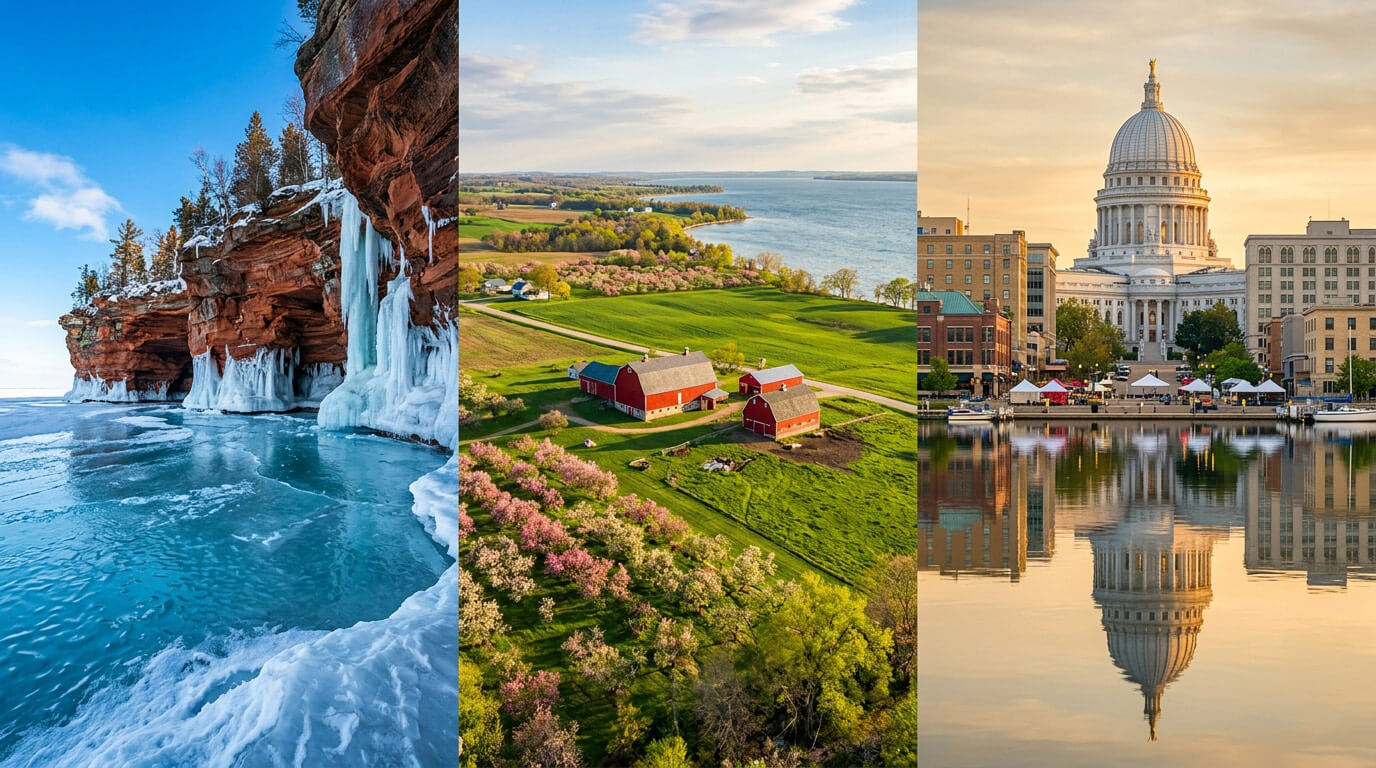
Wisconsin runs from Milwaukee's Lake Michigan brewing scene to the sandstone gorges of Wisconsin Dells and the quiet fishing villages of Door County, all wrapped around a dairy and cheese industry that shapes the state's identity as much as any city does. Green Bay carries an outsized cultural weight for its size as the smallest market in major American professional sports, entirely because of the Packers and Lambeau Field. Madison, the state capital, sits on an isthmus between two lakes, and the Northwoods and Apostle Islands in the state's far north give Wisconsin a genuinely wild side well beyond its cheese-and-football reputation.
Top Attractions, Tours and Tickets in Wisconsin
Milwaukee & Lake Michigan
Milwaukee built its identity on brewing, once home to more breweries per capita than any other American city, and while national giants like Pabst and Schlitz have scaled back, the city's craft beer scene has kept the tradition alive. The Milwaukee Art Museum's Santiago Calatrava-designed Quadracci Pavilion, with wing-like brise soleil that open and close daily, has become the city's most recognizable landmark on the Lake Michigan shoreline. Summerfest, held every summer along the lakefront, calls itself the "World's Largest Music Festival," and the city's Historic Third Ward and Bay View neighborhoods round out a food and arts scene that has grown well past Milwaukee's beer-town reputation.
Book Milwaukee Sightseeing Bus TourWisconsin Dells
Wisconsin Dells calls itself the Waterpark Capital of the World, with more indoor water park space than anywhere else on Earth packed into a town of under 3,000 year-round residents. Beyond the water parks, the Dells take their name from the actual dells, a series of sandstone gorges carved by the Wisconsin River, still explorable by traditional boat tours that predate the water park boom by more than a century. Noah's Ark, the largest outdoor water park in the country, anchors the town's strip alongside dozens of other parks, go-kart tracks, and mini-golf courses built up around family tourism since the late 19th century.
Book Noah's Ark Water Park TicketGreen Bay & Lambeau Field
Green Bay, with a metro population under 350,000, is by far the smallest market with a team in any major U.S. professional sports league, a fact made possible only because the Green Bay Packers remain community-owned by more than 500,000 shareholders rather than a single owner. Lambeau Field, nicknamed the "Frozen Tundra" for its brutal late-season game conditions, has hosted the Packers since 1957 and remains one of the most storied venues in American sports. The surrounding Titletown District has grown into a year-round destination with its own restaurants, an ice rink in winter, and a zipline, giving visitors a reason to come even outside football season.
Book Lambeau Field & Titletown Segway TourDoor County
Door County, the narrow peninsula separating Green Bay from Lake Michigan, packs 300 miles of shoreline and 11 lighthouses into an area often called the "Cape Cod of the Midwest." Fish boils, a Scandinavian-rooted tradition where whitefish, potatoes, and onions are boiled together over an open fire before a dramatic kerosene-fueled boilover, remain a genuine local specialty rather than a tourist gimmick, served at restaurants across the peninsula. Cherry orchards blanket much of the county, and Door County produces more tart cherries than anywhere in the country outside Michigan, celebrated each July at the Door County Cherry Festival.
Book Door County Peninsula Park & Lighthouse CruiseMadison & the Capital Region
Madison sits on a narrow isthmus between Lake Mendota and Lake Monona, giving the city one of the most distinctive layouts of any state capital in the country, with water visible from much of downtown. The University of Wisconsin's flagship campus occupies much of the isthmus's western half, and the Wisconsin State Capitol, with a dome nearly as tall as the U.S. Capitol's, anchors State Street, a pedestrian corridor connecting the two. The Dane County Farmers' Market, held around the Capitol Square every Saturday from spring through fall, is one of the largest producer-only farmers markets in the country.
The Northwoods & Apostle Islands
Wisconsin's Northwoods, covering much of the state's northern third, hold thousands of glacially formed lakes and dense forest that have made the region a summer cabin destination for generations of Wisconsinites and Chicagoans alike. On Lake Superior, the Apostle Islands, a chain of 22 islands near Bayfield, hold sea caves carved into sandstone cliffs that freeze into an otherworldly ice formation most winters, drawing hikers out onto the frozen lake when conditions allow. The islands' six lighthouses, more than any other national park unit in the country, reflect the area's history as a dangerous stretch of water for 19th-century shipping.
Wisconsin's Dairy & Cheese Country
Wisconsin produces more cheese than any other U.S. state, and its "America's Dairyland" license plates are backed up by more than 1,200 licensed cheesemakers, many still small, family-run operations open for tours and tastings across the state's southern and western counties. The state's cheese curds, best eaten fresh and squeaky within hours of production, have become a genuine culinary export well beyond the Midwest, showing up on menus and in grocery stores nationwide. Small towns like Monroe, home to the National Historic Cheesemaking Center, still hold onto the Swiss and German immigrant traditions that shaped Wisconsin's dairy industry in the 19th century.
Major Cities and Places to Visit in Wisconsin
- Milwaukee Tours & Tickets - Wisconsin's largest city, on the shore of Lake Michigan, known for its brewing history, lakefront Milwaukee Art Museum, and a growing food and festival scene.
- Madison Tours & Tickets - Wisconsin's state capital, built on an isthmus between two lakes and home to the University of Wisconsin's flagship campus.
- Green Bay Tours & Tickets - Wisconsin's oldest city and the smallest market in major American pro sports, built around Lambeau Field and the Green Bay Packers.
- Wisconsin Dells Tours & Tickets - The self-declared Waterpark Capital of the World, built around sandstone river gorges and dozens of indoor and outdoor water parks.
- Sturgeon Bay Tours & Tickets - The gateway to Door County, a shipbuilding town on the Door Peninsula surrounded by cherry orchards and Lake Michigan shoreline.
- La Crosse Tours & Tickets - A Mississippi River city in western Wisconsin, framed by bluffs and home to Grandad Bluff's sweeping tri-state overlook.
- Eau Claire Tours & Tickets - A western Wisconsin city at the confluence of the Chippewa and Eau Claire Rivers, home to a growing indie music scene tied to musician Justin Vernon.
- Bayfield Tours & Tickets - A small Lake Superior town and the gateway to the Apostle Islands, known for sea caves, lighthouses, and its historic apple orchards.
Universities, Colleges and Sports Teams in Wisconsin
- University of Wisconsin-Madison in Madison - The state's flagship public research university in Madison, home of the Wisconsin Badgers.
- Marquette University in Milwaukee - A private Jesuit research university in Milwaukee, known for its basketball program.
- Green Bay Packers (sports team) in Green Bay - NFL franchise playing home games at Lambeau Field, uniquely owned by more than 500,000 individual shareholders rather than a single owner.
- Milwaukee Bucks (sports team) in Milwaukee - NBA franchise playing home games at Fiserv Forum in downtown Milwaukee, 2021 NBA champions.
- Milwaukee Brewers (sports team) in Milwaukee - MLB franchise playing home games at American Family Field, known for its retractable roof.
Wisconsin Demographics and Population
According to the 2024 American Community Survey, Wisconsin has a population of approximately 5,914,872 people across 54,158 square miles, ranking it 21st among U.S. states by population. The median household income is $77,488, and the largest racial and ethnic groups are Asian (2.9%), White (81.3%), Hispanic Latino (8%), American Indian and Alaska Native (0.9%), and Black or African American (6.1%). The median age is 40.7 years, and the per capita income is $43,361. Approximately 10.3% of residents live below the poverty line, compared to the national rate of 12.5%. Wisconsin has 2,535,198 households and a mean commute time of 22.7 minutes. Wisconsin produces more cheese than any other U.S. state and remains one of the country's top dairy producers, alongside a manufacturing base built around companies like Harley-Davidson and Kohler, and a tourism industry anchored by Wisconsin Dells and Door County.
When to Visit Wisconsin
Winter (December through February): Cold and snowy, with ice fishing across the Northwoods and Lambeau Field living up to its "Frozen Tundra" nickname during late-season Packers games. Spring (March through May): Mild with maple syrup season in the north and Madison's isthmus lakes starting to open up for boating. Summer (June through August) is the best time to visit Wisconsin. Warm and the peak season for Door County, Wisconsin Dells, and the Apostle Islands, with Milwaukee's Summerfest drawing crowds to the lakefront. Fall (September through November): Cool and colorful, with Door County's cherry harvest and strong foliage across the Northwoods coinciding with the start of Packers season.
Frequently Asked Questions About Touring Wisconsin
Official Wisconsin Resources
The following official government websites provide additional planning resources, park information, and historical records for travelers visiting Wisconsin.
| Resource | Description | Website |
|---|---|---|
| Travel Wisconsin | The state's official travel and tourism site with attraction guides, events, and trip planning tools. | www.travelwisconsin.com/ |
| Wisconsin State Parks | Official listing of Wisconsin's 49 state parks and 15 state forests, run by the Department of Natural Resources. | dnr.wisconsin.gov/topic/Parks |
| Wisconsin Historical Society | State agency responsible for historic sites, archives, and research and genealogy resources, headquartered in Madison. | www.wisconsinhistory.org/ |
| Wisconsin.gov | The official portal for Wisconsin state government services and information. | www.wisconsin.gov/ |